

Collaborative Robotics vs. Traditional Automation
What’s the Difference?
Industrial robots have become the backbone of modern manufacturing, reshaping how products are assembled, packaged, and delivered. Across industries, automation is now a necessity for staying competitive.
Yet as the adoption of robotics accelerates, one key question continues to arise: what exactly separates collaborative robotics, often known as cobots, from traditional automation? Below, we'll take a closer look at these differences, because they're critical for manufacturers evaluating automation investments.
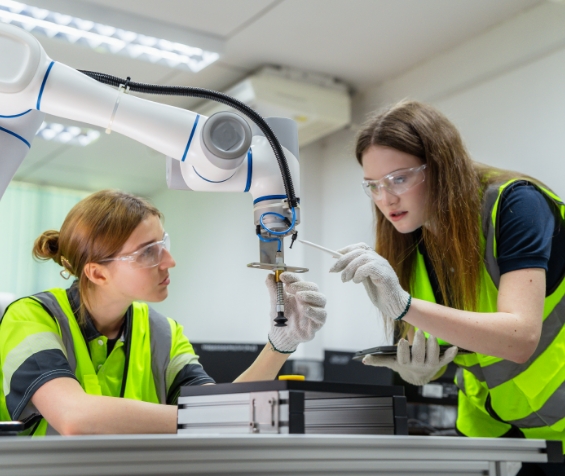
Explaining Both Options: Robot 101
Both technologies are designed to increase efficiency, reduce errors, and enhance production capacity, but they take fundamentally different approaches.
Traditional robotic systems are built for speed and power, optimized for repetitive, high-volume tasks in controlled environments. Cobots, by contrast, are designed to share workspace with humans safely, offering flexibility and ease of use that older systems can’t match.
Once you recognize where each approach excels, you can select the technology that best fits your company's production goals, workforce needs, and long-term strategy.
The Evolution of Industrial Robots and Automation
Automation has evolved from simple, isolated machines into interconnected systems that combine intelligence, precision, and adaptability. Each stage of this evolution reflects how manufacturing itself has changed, from high-volume mass production to flexible, customized operations like robotic welding systems and more.
From Fixed Systems to Flexible Cells
In its earliest forms, industrial automation relied on rigid, high-throughput systems designed for one purpose. These machines excelled at repeatable tasks like stamping, welding, or palletizing, but lacked the ability to adjust when products or processes changed.
The Rise of Human–Robot Collaboration
The introduction of cobots marked a turning point. These systems include sensors, force limits, and safety-rated controls that allow them to work directly alongside human operators. Instead of requiring isolation or guarding, cobots complement human skill, handling physical or repetitive steps while workers focus on oversight, programming, and quality.
Why This Shift Toward Robotic Automation Matters
As markets move toward smaller batch sizes and greater product variation, manufacturers need automation that adapts quickly. Human–robot collaboration combines flexibility with safety, allowing plants to manage high-mix, low-volume production without sacrificing consistency or speed.
Ultimately, the evolution of automation reflects the broader transformation of manufacturing: toward agility, responsiveness, and smarter use of both human and machine capability.
Key Differences Between Collaborative Robots and Traditional Industrial Robots
Although both collaborative and traditional robotic systems share the same goal (improving productivity), they differ significantly in how they achieve it. Understanding these distinctions can help you, as a manufacturer, determine which option aligns best with your environment and goals.
Collaborative Robots Vs. Traditional Industrial Robots in the Manufacturing Industry
- Safety and Interaction: Cobots are designed for direct human interaction, featuring built-in sensors and force limits that prevent injury. Traditional robots, built for power and speed, typically operate inside guarded cells to maintain safety.
- Flexibility: Cobots can be reprogrammed quickly and redeployed across multiple tasks. They’re ideal for smaller manufacturers or lines that frequently change products. Traditional robots shine in stable, repetitive, high-volume environments where precision and output are paramount.
- Footprint and Setup: Cobots require less space and can be installed without major infrastructure changes. Traditional systems often involve engineered cells, conveyors, and safety enclosures: perfect for large, continuous production but less agile.
- Cost and ROI: Cobots have a lower upfront installed cost and faster deployment timeline, offering quicker payback. Traditional automation, while more capital-intensive, provides long-term ROI when dedicated to large-scale, consistent production.
- Use Cases: Cobots excel at tasks like assembly, welding, inspection, and light material handling, where human coordination is valuable. Traditional systems are preferred for welding, heavy lifting, and other high-force or precision-intensive operations.
Both technologies have their place. The key is not to view cobots as replacements for traditional automation, but as complementary tools. Each plays a role in creating a balanced, efficient, and future-ready production ecosystem.
When to Choose Collaborative Robotics
Collaborative robots are transforming the manufacturing industry by making automation more accessible to businesses of every size. While traditional industrial robots still dominate high-volume production, cobots excel in environments where flexibility, adaptability, and direct human-robot interaction are essential.
Cobots or Traditional High Volume Robots? What's Right For Your Operation?
Small and Mid-Sized Manufacturers
For smaller facilities, cobots are often the first practical step into robotic automation. They require lower capital investment and less infrastructure than conventional systems. A single robot arm can be reprogrammed to handle packaging, assembly, or inspection tasks across different lines, making automation attainable for operations that can’t dedicate floor space to large-scale systems.
Variable or Seasonal Production
Cobots are ideal for high-mix production, where product runs change frequently or seasonally. Their force control and quick setup allow manufacturers to reassign robots to new stations or tasks with minimal downtime. The added flexibility lets companies respond to market shifts faster than traditional automation would allow.
Tasks Requiring Human Oversight
Some manufacturing operations still benefit from human intervention. Cobots can work alongside humans to perform repetitive or precision-dependent jobs such as packaging, inspection, or the robotic welding process. In many cases, cobots assist human welders by handling part positioning, while skilled welders focus on fine work like arc welding or laser welding that demands judgment and experience.
Workforce Support and Safety
Cobots also improve workplace ergonomics by taking over dangerous tasks or those requiring repetitive strain. Whether feeding parts into a wire feeder or lifting components on the factory floor, these robots protect human workers and reduce fatigue. By embedding proper safety measures, facilities enhance both morale and productivity.
Cobots ultimately offer flexibility and accessibility that traditional systems can’t match. Their ability to adapt to changing conditions, complement human skills, and operate safely in shared spaces makes them a powerful addition to modern production environments.
Deciding Between Cobots and Traditional Automation? Keep These Points in Mind
Both collaborative and traditional systems can deliver strong results...but only when matched correctly to the application. Avoiding these common mistakes ensures an investment that meets long-term goals.
Overestimating Cobots’ Capabilities
Not every process suits light-duty cobots. Tasks involving extreme payloads, speed, or precision may still require traditional systems or welding robots designed for heavy-duty applications.
Ignoring Integration Requirements
Cobots and traditional automation must connect seamlessly with existing lines. Overlooking this step creates workflow disruptions and limits ROI.
Neglecting Safety Validation
Even collaborative robots require a formal risk assessment and proper setup. Comprehensive safety measures ensure that cobots operate as intended when sharing space with employees.
Failing to Consider Long-Term Scalability
As product demand grows, systems must evolve. Some processes, especially in additive manufacturing or high-volume assembly, may eventually outgrow cobot capacity.
Thorough evaluation prevents mismatched technology and ensures automation delivers consistent performance over time.
Why Melton Is a Leader in Robotic Integration
With more than 55 years of experience, Melton Machine & Control Company has become a trusted name in robotic system design, engineering, and integration. Our expertise spans both collaborative robotics and traditional industrial robots, allowing us to deliver tailored solutions for every environment.
Melton’s integrated engineering approach covers welding, material handling, and inspection automation, ensuring each component works as part of a cohesive system. We build scalable solutions designed for long-term reliability and seamless collaboration between humans and machines.
At Melton, our philosophy is simple: provide a solution that works for you because it was made for you. Whether you need cobots that share workspaces safely or automated systems for complex, high-volume production, our dedicated team partners with you to create lasting value. Contact us today and get your cobot journey started.
Start a Conversation with the Melton Today
Your goal isn’t to choose between cobots and traditional automation ... it’s to find the right balance for your unique manufacturing operations. When designed thoughtfully, both systems can work together to maximize safety, flexibility, and output.
If you’re ready to explore how robotic systems can improve your operation, now is the time to take the next step. Start a conversation with Melton today, and build a future-ready automation strategy for your factory floor.