Rotary Welding Machines

A Machine Tailor-Made for Your Business

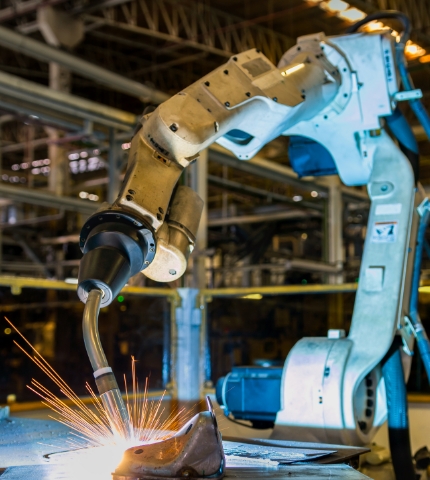
Rotary welding machines are dedicated automated welding systems that rotate a part through a controlled weld while the torch remains fixed or follows a defined motion. Built for repeatable welding applications, these systems are often used when manufacturers need higher throughput, consistent weld quality, and straightforward operation for producing the same or similar parts in volume.

The key benefits of a dedicated system like a rotary station are that they usually have higher throughput than a robot cell, usually have a lower installed cost, and are easier to maintain at facilities where high-tech set-up mechanics are in short supply.

Ease of set-up, ease of operation, and ease of maintenance all add up to a viable solution for welding the same part in quantity.

Types of Automated Rotary Welding Machines

Rotary welding machines are essential production systems for various industries, from manufacturing to construction. To ensure optimal performance and efficiency, it's crucial to select the right type of welding machine for your specific application.

At Melton, we can help you find an automated welding solution for your needs, including a customized version of one of the following rotary machines:

Horizontal Welding Machines

Horizontal welding machines are designed to weld parts in a horizontal position, promoting efficient welding of multiple parts simultaneously, particularly large and heavy components. Key features include:

  • Single-axis control: For precise movement of the welding torch.
  • Cam-controlled torch motion: Ensures consistent weld quality.
  • Flexible axis configurations: Adaptable to various welding tasks.
  • One-piece fixture frame: Provides stability and rigidity.

Incline Welding Machines

Incline welding machines utilize gravity to assist in the welding process. This is particularly beneficial for welding parts of different thicknesses. Key features include:

  • 360-degree weld angle: Offers flexibility and precision.
  • Expanded working space: Accommodates various workpiece sizes.
  • LED lighting: Improves visibility.
  • Modular fixture frame: Customizable for different applications.

Vertical Welding Machines

Vertical welding machines are ideal for welding parts in an upright position, saving valuable floor space. They are particularly suited for welding tall or narrow components. Key features include:

  • Modular fixture frame: Adaptable to various workpiece configurations.
  • Flexible spindle face plate: Accommodates different workpiece sizes and shapes.
  • Safety features: Arc curtains, area scanners, and safety light curtains.
  • Advanced features: Torch oscillation, barcode scanners, and vision systems.

Linear Welding Machines

Linear welding machines are used for long, continuous welds on flat or angular components. The welding torch moves in a straight line, ensuring consistent weld quality. Key features include:

  • Precise linear motion: For accurate and repeatable welds.
  • High-speed welding: Increases productivity.
  • Reduced operator fatigue: Minimizes physical strain.

Press Welders

Press welders use pressure and heat to join metal parts. A press welder is ideal for high-strength welds and is commonly used in the automotive and aerospace industries. Key features include:

  • High-pressure capability: Ensures strong and durable welds.
  • Precise control: Accurate control of pressure and heat.
  • Versatile applications: Suitable for a wide range of materials and thicknesses.
  • Reduced cycle times: Efficient welding process.


By understanding the capabilities and limitations of these different types of welding machines, you can select the most appropriate equipment for your specific welding needs.

How Do You Choose the Right Rotary Welding Machine?

Choosing the right rotary welding machine starts with the part and the production requirements surrounding it. Part size, weight, geometry, and weld location can determine how the workpiece needs to be positioned, while available floor space may make one machine orientation more practical than another. For some applications, an incline configuration can also use gravity to support the welding process.

Production volume and required throughput are equally important. Rotary welding machines are particularly effective when the same or similar parts need to be welded repeatedly at high volumes. However, cycle time should account for more than the weld itself. Loading, fixturing, welding, unloading, and transferring the finished part all affect how quickly the overall operation can run.

Part variation also influences the decision. Finally, consider how the machine will fit into the rest of production. Upstream and downstream equipment, operator interaction, material movement, controls, safety requirements, and available floor space should all be evaluated before the system is designed.

System Integrations and On-Site Support

From a simple cell to a complex configuration that includes operator work instructions, we produce rotary welding machines designed to integrate with your existing production environment. Our team can account for controls, material flow, operator interaction, and surrounding equipment so the new system supports your overall workflow rather than operating as an isolated machine.

Support continues after installation. When hands-on assistance is needed, our machine experts can travel to your facility to help keep your rotary welding equipment operating as intended. On-site support services include:

  • Machine troubleshooting and repair
  • Operator training
  • Preventive maintenance and inspections


Contact us today to explore how our integration and on-site support capabilities can benefit your operation.
Innovative Welding Solutions – Decades of Experience

With more than 55 years of experience under our belts, the Melton team brings the perfect combination of innovation and proven processes to the table to help complete your unique automation project.

We work directly with your operators and production managers to ensure the solution will integrate and operate seamlessly for years to come. Choosing rotary welding machines from Melton offers unmatched flexibility and control, especially for projects requiring intricate welds. Schedule a free assessment today.

robotic laser welding

Frequently Asked Questions About Rotary Welding Machines

What Is a Rotary Welding Machine?

A rotary welding machine is a dedicated automated welding system that rotates a part through a controlled weld while the welding torch remains fixed or follows a defined motion. These machines are commonly used for repeatable, high-volume applications where consistent weld quality and efficient cycle times are priorities.

When Should You Use a Rotary Welding Machine Instead of a Robotic Welding Cell?

A rotary welding machine can be a strong choice when you produce the same or similar parts in high volumes with relatively consistent weld paths. Dedicated rotary systems can offer higher throughput, simpler operation, and a lower installed cost for these applications. A robotic welding cell may be better suited to complex weld paths, frequent part changes, or applications requiring greater flexibility.

How Much Does a Rotary Welding Machine Cost?

The cost of a rotary welding machine depends on the application, machine configuration, tooling, controls, safety equipment, integration requirements, and level of customization. Defining your parts, production goals, and required throughput early helps determine which capabilities are necessary and provides a clearer basis for estimating the investment.

Can a Rotary Welding Machine Increase Throughput?

Yes. Rotary welding machines can increase throughput by automating repeatable welding operations and maintaining consistent cycle times. Actual production gains also depend on part loading, fixturing, unloading, material transfer, and other processes surrounding the weld, which should be considered when designing the complete system.

What Is an Incline Welding Machine?

An incline welding machine is a rotary welding system that positions the workpiece at an angle during welding. This configuration allows gravity to assist the welding process and can provide a more favorable weld position for certain parts, joint configurations, and applications.

How Long Does It Take to Implement a Custom Rotary Welding System?

Implementation time varies based on the complexity of the application, custom engineering requirements, tooling, controls, equipment procurement, testing, installation, and integration with existing production equipment. Defining these requirements early in the project helps establish a realistic design, build, and implementation schedule.

START A CONVERSATION

You’re only a few simple steps away from the start of your automation journey. It all starts with a quick, free assessment from the Melton team to ensure we fully understand your needs and undertake a process that best meets them. Fill out our contact form below to start the conversation and schedule a free assessment.

This field is for validation purposes and should be left unchanged.
By providing a telephone number, email address, and submitting this form you are consenting to be contacted by email and SMS text message. Message & data rates may apply. You can reply STOP to opt-out of further messaging. We will never share your personal information with third parties for marketing purposes. Privacy Policy

Partners and Affiliations