
Robotic Welding as Part of an Automated Production Line
In many facilities, robotic welding begins as a standalone solution: a single cell added to improve consistency or relieve labor pressure. This approach can deliver immediate gains, but its full potential is realized only when it becomes part of a coordinated, automated production line.
Welding does not operate in isolation. It depends on upstream material flow, downstream inspection, and synchronized cycle timing across multiple processes.
When top manufacturers evaluate automation strategically, they look beyond the welding robot itself. They examine how parts move, how quality is verified, and how data flows through the system. That's why in today's blog, we're exploring how integrating welding into a broader automation framework transforms it from a productivity upgrade into a production multiplier.
Why Robotic Welding Alone Isn’t Enough
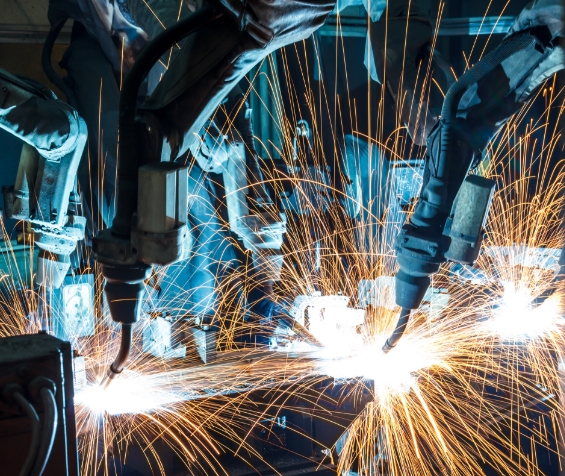
A standalone robotic welding cell can improve weld consistency and reduce repetitive manual tasks. However, without integration, it may introduce new inefficiencies elsewhere in the workflow.
The Limits of a Standalone Welding Cell
When welding is automated but loading and unloading remain manual, throughput often stalls at the transfer point. Operators may struggle to keep pace with cycle times, creating idle robot time and uneven production rates. Inconsistent part presentation can also introduce variation, reducing the consistency automation was meant to deliver.
Where Production Lines Break Down
Breakdowns in synchronization frequently occur between welding, material handling, and inspection. Parts may queue upstream waiting for positioning. Downstream quality checks may lag behind production. Without coordinated sequencing, automation can amplify imbalance rather than eliminate it.
The result is a system that performs well in isolation but fails to optimize overall manufacturing performance.
What a Robotic Welding Automation Production Line Actually Includes
An automated production line is more than a collection of machines. It is an engineered ecosystem where material flow, welding, inspection, and controls operate in coordination.
What Should A Fully Automated Production Line Really Look Like?
Material Flow and Part Presentation
Material Handling Automation plays a central role in line performance. Automated loading and unloading systems ensure consistent part orientation and timing, reducing variability before welding begins. Conveyors, positioners, and transfer systems maintain predictable flow between stations.
When part presentation is controlled, weld quality and cycle time become far more stable.
Robotic Welding Processes and Systems Within the Line
Robotic Welding Systems form the core of many automated production lines. Whether configured as single-station or multi-station cells, these systems must be balanced against upstream and downstream processes. Proper cycle time matching ensures that welding neither starves nor overwhelms the line.
In-Line Quality Verification
Quality control is most effective when integrated into the line itself. Robotic Quality Control systems can inspect welds automatically, reducing reliance on post-process checks and minimizing rework. Early detection of defects prevents downstream disruption and protects production schedules.
Data and Process Feedback Loops
Automated production lines generate valuable operational data. Monitoring parameters such as cycle time, weld current, and system uptime enables manufacturers to identify trends before they become problems. When welding data feeds into broader production analytics, decision-making becomes proactive rather than reactive.
The Role of System Integration in Your Automated Welding Solutions
Automation succeeds when it is engineered as a cohesive system rather than assembled as separate components. System Integration ensures that mechanical, electrical, and software elements function together seamlessly.
Here are a few reasons why system integration is so important for welding robots.
Mechanical Integration
Fixturing, part positioning, and transfer mechanisms must align precisely with welding requirements. Mechanical integration guarantees repeatable alignment and smooth transitions between stations, reducing wear and misalignment.
Electrical and Controls Integration
Robots, conveyors, quality systems, and safety devices must communicate through a unified controls architecture. Electrical integration synchronizes motion, interlocks, and process timing to prevent bottlenecks and improve reliability.
Programming and Sequencing
Coordinated programming ensures that each station operates within balanced takt times. When welding cycles are aligned with material handling and inspection, throughput remains steady and predictable.
Startup and Commissioning
A successful automated production line requires structured commissioning. Testing, validation, and operator training confirm that performance targets are met before full-scale production begins. Careful startup reduces disruption and accelerates return on investment.
Benefits of Welding Inside a Fully Automated Line
When robotic welding is embedded within an automated production line, the result is both high-quality welds and many operational benefits that extend beyond the weld itself.
How Fully Automated, Integrated Lines Help Produce High Quality Welds
- Balanced throughput: Coordinated timing across stations reduces idle time and maintains steady production flow.
- Reduced bottlenecks: Automated material handling prevents part congestion at transfer points.
- Improved weld consistency: Controlled part presentation and synchronized sequencing support repeatable weld quality.
- Lower labor dependency: Automation reduces manual intervention in repetitive transfer and inspection tasks.
- Enhanced traceability: Integrated data collection improves quality documentation and compliance.
- Scalability for growth: Modular system design allows manufacturers to expand capacity without disrupting existing workflows.
These gains are most pronounced when automation is planned as a unified system rather than layered onto existing inefficiencies.
When Does Full-Line Automation Make Sense?
Not every operation requires complete production line automation. However, over the years, we've consistently seen specific indicators that reveal when full-line welding integration could deliver measurable impact.
Indicators you've outgrown a single welding cell include:
- Increasing production volume: Rising demand strains manual loading and inspection processes.
- Multiple process handoffs: Frequent part transfers introduce delay and variability.
- Accumulating rework: Quality checks occur too late in the process.
- Operator strain: Repetitive handling tasks limit workforce sustainability.
When these conditions appear, evaluating full-line automation can reveal opportunities to stabilize performance.
Industries That Benefit Most From Full-Line Robotic Welding Automation Solutions
Automated welding lines are common in automotive manufacturing, heavy equipment production, and facilities producing fabricated metal components. These environments often combine consistent part geometry with high throughput demands, making integrated automation particularly effective. The result is improved efficiency, reduced variation, and stronger alignment between engineering intent and final output.
Operations that compete on delivery speed and consistency also gain a measurable competitive edge when robotic welders handle repetitive arc processes. That's because these solutions allow skilled welders to focus on higher-value work that draws on their welding experience and technical expertise. Instead of replacing welders, automation complements their tools and knowledge, enabling teams to complete large production runs in record time while maintaining uniform standards.
Melton Machine & Control Company Can Help You Build a Unified Automation Strategy
Whether supporting MIG or TIG applications, robotic welding automation helps companies meet customer expectations with greater reliability and confidence. However, robotic welding also delivers its greatest value when it's embedded within a coordinated production line as a system-level integration.
With more than 55 years of experience designing and integrating automated systems, Melton approaches every project with a systems mindset. Our team engineers solutions that prioritize safety, reliability, and long-term scalability.
If you're evaluating how robotic welding automation fits into your broader automation strategy, we can help. Start a conversation to explore how an integrated approach to robotic welding can strengthen your manufacturing performance.
Start a Conversation
Start a Conversation with the Melton Today
Consistency is the foundation of welding quality, and cobots are only as good as the systems that monitor and maintain them. Treating audits as a strategic investment, not a maintenance chore, ensures lasting productivity and a higher return on every automation asset.
Start a conversation with us to strengthen your cobot welding quality program and build a future defined by precision, reliability, and consistent excellence.
Start a Conversation with the Melton Today
Consistency is the foundation of welding quality, and cobots are only as good as the systems that monitor and maintain them. Treating audits as a strategic investment, not a maintenance chore, ensures lasting productivity and a higher return on every automation asset.
Start a conversation with us to strengthen your cobot welding quality program and build a future defined by precision, reliability, and consistent excellence.