

How Does a Robotic Welding Cell Work? Step-by-Step Breakdown
Robotic welding is often discussed in terms of the robot itself: the arm, the motion, the precision. In reality, the robot is only one part of a larger system. What actually enables repeatable, high-quality welding in an automated environment is the robotic welding cell, a controlled production space where equipment, programming, fixturing, and safety systems operate together.
But how does a robotic welding cell work? After all, for manufacturers evaluating welding automation, understanding how the entire cell functions is essential. A robot alone cannot guarantee consistent welds. Repeatability comes from the interaction of multiple components, from how parts are positioned to how weld parameters are controlled and monitored throughout production.
A robotic welding cell integrates these elements into a coordinated workflow. By stabilizing each stage of the process, the system allows manufacturers to produce consistent welds across hundreds or thousands of identical parts. In the article below, we'll share the step-by-step process of exactly how these cells work.
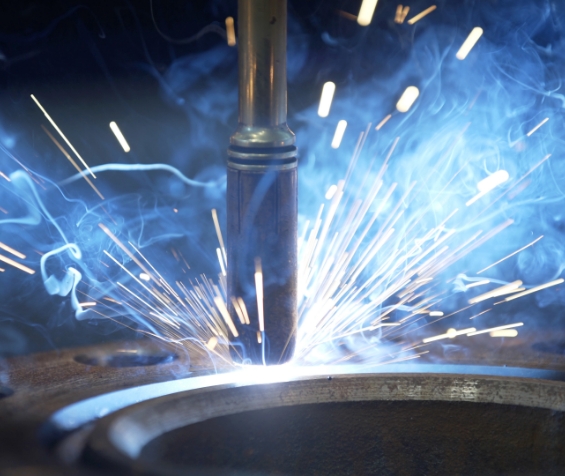
What Is a Robotic Welding Cell? How Does It Help With Repeatable Welds?
A robotic welding cell is a dedicated manufacturing environment where welding automation can operate safely and predictably. It combines mechanical systems, welding equipment, programming controls, and safety infrastructure into a single coordinated unit.
The goal of the cell is not simply to automate welding, but to create conditions where the welding process can be repeated with minimal variation. When parts are presented consistently, and weld parameters remain stable, the robot can reproduce identical welds across extended production runs.
Cells also provide the controlled environment needed to protect operators and maintain process reliability. Guarding, sensors, and safety interlocks ensure that the system operates within defined boundaries while maintaining production efficiency. Instead of a single automated tool, a robotic welding cell functions as a complete production station designed around repeatable manufacturing.
Core Components of a Robotic Welding Cell for Automated Welding
A robotic welding cell relies on several integrated components that work together to support the welding process. Each element contributes to maintaining stability, precision, and safe operation during production.
Here are some core components of an automated robot cell for the welding industry:
- Industrial robot arm: The robot provides multi-axis motion that positions the welding torch with high accuracy. Once programmed, the arm repeats the same movement path for every weld, ensuring consistent bead placement.
- Welding power source: The power supply controls the electrical parameters of the welding process, including voltage and current. Stable power delivery is critical for maintaining consistent arc behavior.
- Welding torch and consumables: The torch directs the welding arc while delivering filler material when required. Proper torch alignment and consumable condition directly influence weld quality.
- Fixturing and positioners: Fixtures hold components in a precise orientation so the robot encounters identical joint geometry during each cycle. Positioners may rotate or tilt parts to allow the robot to reach complex weld seams.
- Robot controller: The controller executes the programmed weld sequence, managing motion paths, travel speeds, and parameter timing.
- Safety systems: Guarding, interlocks, and sensor systems ensure the cell operates within safe boundaries while allowing operators to interact with the system during setup or maintenance.
While these components can vary between installations, their coordinated interaction is what allows the cell to maintain repeatable welding performance.
How Does a Robotic Welding Cell Work For Repetitive Welding Tasks? A 5 Step Process
Step 1: Part Loading and Fixturing for the Robotic Welding Process
Every welding cycle begins with presenting the part to the robot in a consistent position. This step is often overlooked, but it is one of the most critical factors in achieving repeatable weld quality.
Parts may be loaded manually by an operator or transferred into the cell using automated material handling equipment. Regardless of the method, the goal is to position the component within the fixture so that the robot encounters the same weld joint location every time.
Fixtures play an essential role in this process. By securing parts in precise alignment, they eliminate variation in joint position or orientation. Even small differences in part placement can affect weld penetration or bead geometry, so properly engineered fixturing ensures the welding process begins under controlled conditions.
When part presentation remains stable, the robot can follow its programmed weld path with predictable results.
Step 2: Welding Robots' Program Selection and System Setup
Before welding begins, the correct program must be selected and verified. Each product or part configuration typically has a specific program that defines the weld path, parameter settings, and sequence of operations.
Operators confirm that the appropriate program is loaded into the robot controller and that the system is prepared for the welding cycle. This includes verifying that fixtures are properly loaded, safety systems are active, and welding consumables are ready.
Programming defines how the robot will move and how the welding arc will behave throughout the process. Parameters such as travel speed, voltage, amperage, and wire feed rate are carefully configured to produce the desired weld characteristics.
By locking these conditions into the system, robotic welding removes much of the variability that occurs in manual welding.
Step 3: Robotic Weld Execution for Laser Welding, Arc Welding, and More
Once setup is complete, the robotic welding cycle begins. The robot follows its programmed path while controlling both motion and welding parameters with precision.
Path Movement and Torch Positioning
The robot arm moves the welding torch along the defined weld seam at a consistent speed and angle. Because the robot repeats this motion with extremely high accuracy, each weld follows the same trajectory.
This consistency allows the welding process to remain stable across multiple production cycles.
Welding Parameter Control
At the same time, the welding system maintains controlled electrical parameters. Voltage, amperage, and wire feed speed remain consistent throughout the weld sequence, ensuring stable heat input and predictable penetration.
Maintaining these parameters within narrow limits helps produce uniform weld beads and reduces defects caused by process variation.
Coordinated Motion With Positioners
In many cells, the robot works together with positioners that rotate or reposition the part during welding. This coordination allows the system to maintain the optimal weld orientation while accessing complex joints.
By synchronizing robot movement with part positioning, the system ensures consistent weld quality even on intricate assemblies.
Step 4: Monitoring and Quality Verification with Robotic Welding Equipment
Robotic welding systems often incorporate monitoring capabilities that track welding parameters and system performance during operation.
Detecting Irregularities
These monitoring systems can detect irregularities in voltage, current, or arc behavior, alerting operators if the process deviates from expected conditions. Early detection allows issues to be addressed before they affect large batches of parts.
The Inspection Process
After welding is complete, parts may undergo inspection to verify weld quality and dimensional accuracy. Inspection methods can range from visual checks to sensor-based measurement systems, depending on production requirements.
By integrating monitoring and inspection within the production workflow, manufacturers can maintain consistent quality standards across long production runs.
Step 5: Part Removal and Cycle Reset
Once the welding process is complete, the finished component is removed from the fixture, and the cell prepares for the next production cycle.
In some facilities, operators unload parts manually and place the next component into position. In others, automated handling systems transfer finished parts to downstream processes while presenting new components to the welding station.
The cell then resets and begins the next cycle using the same programmed motion and welding parameters. This repeatable sequence allows robotic welding systems to maintain stable cycle times and predictable production output.
Why Robotic Welding Works Best With Skilled Operators
Despite the high level of automation within robotic welding cells, skilled personnel remain essential to the process.
Skilled welders and technicians play a central role in programming weld paths, validating welding procedures, and refining process parameters. Their understanding of metallurgy, joint design, and weld behavior ensures that automated systems produce structurally sound results.
Operators also monitor system performance, inspect weld quality, and adjust programs when product designs or materials change. The robot executes the process, but human expertise defines how the process should operate.
What Makes a Robotic Welding Cell or Cobot Welding Cell Successful?
A robotic welding cell performs best when the surrounding manufacturing process supports consistency. Stable fixturing, clean part preparation, and well-defined welding parameters all contribute to reliable automation.
Successful cells are also carefully integrated into the broader production workflow. Material handling, inspection processes, and upstream fabrication steps must align with the rhythm of the automated system.
When these elements are designed together, the cell can maintain stable output, reduce variation, and improve overall production efficiency.
Melton Machine & Control Company Can Build a Robotic Welding Cell Around Your Process
A robotic welding cell works by controlling the welding process step by step. From part positioning and program selection to weld execution and inspection, each stage contributes to maintaining repeatability across production runs.
The robot itself provides precise motion, but the surrounding system (fixturing, power control, programming, and monitoring) is what enables consistent welding performance.
With more than 55 years of experience designing and integrating robotic welding systems, Melton helps manufacturers build automation solutions tailored to their production needs. Wondering how to automate repetitive welding tasks or achieve consistent weld quality with robotics? We can help.
If you’re exploring robotic welding for your operation, start a conversation with us today to discuss how automation can support your manufacturing goals.
Start a Conversation with the Melton Today
Consistency is the foundation of welding quality, and cobots are only as good as the systems that monitor and maintain them. Treating audits as a strategic investment, not a maintenance chore, ensures lasting productivity and a higher return on every automation asset.
Start a conversation with us to strengthen your cobot welding quality program and build a future defined by precision, reliability, and consistent excellence.