

How Robotic Welding Improves Weld Consistency and Repeatability
Increasingly, weld quality is measured not only by strength or appearance, but by consistency across every production run. A weld that meets specification once is valuable, but a process that produces identical results thousands of times is what allows manufacturers to maintain reliability, reduce defects, and meet strict inspection standards.
This is where weld consistency and repeatability become critical. When weld parameters, positioning, and joint preparation remain stable, manufacturers can produce parts that meet engineering requirements without constant adjustments or rework. However, maintaining that level of stability over long production runs can be difficult with manual welding alone.
By combining programmable motion, repeatable positioning, and consistent parameter control, robotic systems help manufacturers achieve predictable weld performance across high-volume and repetitive production environments. In this blog, we'll share exactly how robotic welding improves consistency.
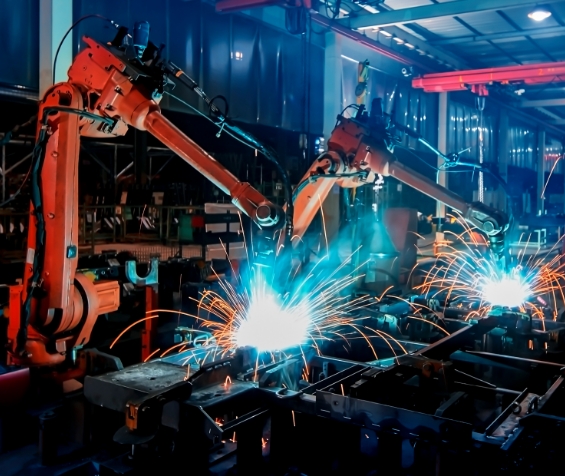
Weld Variability in Manual Processes: How Robotic Welding Consistency Can Help
Manual welding relies heavily on operator skill, attention, and physical endurance. Skilled welders can produce exceptional results, but maintaining identical weld characteristics across long shifts or large production runs introduces natural variability.
Here are the downsides of manual welding and human error:
Operator Variation and Fatigue
Even experienced welders introduce small variations in technique during manual welding. Torch angle, travel speed, arc length, and positioning can shift slightly from weld to weld. Over time, physical fatigue can amplify these variations, particularly during repetitive welding tasks.
These small changes may not be visible immediately, but they can influence penetration depth, bead geometry, and heat distribution within the weld joint.
Environmental and Setup Variables
Manufacturing environments also introduce variables that affect weld consistency. Minor changes in part fit-up, fixture alignment, or material condition can alter how the weld pool behaves.
Temperature fluctuations, inconsistent part positioning, or joint gaps may require operators to adjust technique mid-process. While skilled welders compensate for these factors, each adjustment introduces the potential for variation.
Process Drift Over Time Interferes with Consistent Quality Welds
Across long production runs, small variations accumulate. Differences between operators, shifts, or setups can create process drift that affects overall weld quality. In many cases, inconsistencies are only discovered during inspection or downstream assembly.
Robotic welding consistency reduces these fluctuations by stabilizing the welding process and enforcing consistent execution across every cycle.
How Robotic Welding Consistency Controls Critical Welding Variables
One of the primary advantages of robotic welding is its ability to maintain precise control over the variables that influence weld quality. Here are the specific variables that a robotic welding process will give you more control over.
Consistent Torch Angle and Motion
A robotic welding arm follows programmed paths with extremely high repeatability. Once a weld path is defined, the robot maintains the same torch angle, travel distance, and positioning for every part produced.
This consistency ensures that the weld bead is placed exactly where engineers intended, reducing variation across identical components.
Stable Travel Speed and Arc Behavior
Robotic systems maintain constant travel speeds and arc conditions throughout the weld sequence. In manual welding, even slight speed changes can alter heat input and bead formation.
Automation eliminates this variability by executing the programmed weld path at identical speeds every cycle, supporting stable arc behavior and predictable penetration.
Repeatable Part Positioning Minimizes Welding Inconsistencies
Robotic welding systems typically work alongside precision fixtures and coordinated positioners that hold parts in the same orientation for each cycle.
Consistent part presentation ensures that the robot encounters identical joint geometry every time, improving weld quality and minimizing setup variation.
Programming Process for Welding Parameters
In robotic welding, key parameters such as amperage, voltage, wire feed speed, and sequence timing are programmed into the system.
This eliminates guesswork and ensures that every weld is performed using the same controlled conditions. When properly validated, these programmed parameters produce repeatable weld performance across large production runs.
Repeatability: The Core Advantage of a Welding Robot
Repeatability is one of the defining advantages of robotic welding systems.
In manufacturing, repeatability refers to the ability to perform the same operation repeatedly with minimal variation. In welding, this means reproducing identical weld paths, heat inputs, and bead profiles across every part produced.
Welding robots allow for repeatable, high-quality welds in the following ways:
Identical Weld Paths Every Cycle
A programmed robot follows the exact same motion sequence for every weld. This precision eliminates many of the subtle variations that occur in manual welding.
As a result, weld beads remain consistent in size, penetration, and location across production runs.
Reduced Defects and Rework
When weld conditions remain stable, manufacturers experience fewer defects such as undercutting, incomplete fusion, or inconsistent bead profiles.
Every reduction in variability leads to lower scrap rates, fewer repairs, and improved production efficiency.
Predictable Inspection Outcomes
Consistent weld geometry also simplifies inspection processes. When weld profiles remain uniform, non-destructive testing methods such as ultrasonic or visual inspection can be performed more reliably.
Repeatability allows quality teams to verify compliance more efficiently and maintain confidence in production output.
Robotic Welding Consistency and Quality Assurance
Robotic welding consistency and repeatability also support broader quality assurance strategies, including:
Process Monitoring and Data Capture
Many robotic welding systems include monitoring capabilities that record welding parameters and process data during production.
Tracking parameters such as voltage, current, and cycle timing allows manufacturers to verify that each weld meets defined process conditions.
Integration with Automated Inspection
Robotic systems can also integrate with automated inspection technologies that measure weld quality, dimensional accuracy, or component alignment.
Embedding inspection within the production workflow helps manufacturers detect issues earlier and maintain stable quality standards.
Improved Traceability
Manufacturers operating in regulated industries often require detailed documentation of production processes. Robotic welding systems help support traceability by recording process data and maintaining consistent execution across batches.
This capability strengthens compliance with internal quality standards and external regulatory requirements.
Top Industries Where Robotic Welding Delivers the Greatest Consistency, Welding Speed, Workplace Safety, and Cost Savings
While robotic welding can benefit many manufacturing environments, it delivers the greatest advantages in applications with repeatable processes and consistent part geometry.
Industries that commonly benefit from robotic welding include:
- Automotive manufacturing: Automotive production relies on repeatable weld joints, high throughput, and strict quality standards, making robotic welding systems ideal for maintaining consistent weld geometry across large production runs.
- Heavy equipment production: Manufacturers producing frames, structural components, and reinforced assemblies use robotic welding to maintain precise weld placement and penetration on thick materials.
- Structural steel fabrication: Robotic systems help fabricators produce long seam welds and repetitive structural joints with improved consistency and reduced variation between shifts.
- Agricultural equipment manufacturing: Equipment manufacturers benefit from automation when producing repeatable welds on frames, housings, and mechanical assemblies that require durable construction.
- Contract fabrication operations: Fabricators producing moderate-to-high volumes of similar parts can use robotic welding to stabilize throughput and maintain predictable quality across customer projects.
The sectors above often involve long seam welds, repetitive weld joints, and medium-to-high production volumes. In these environments, robotic systems help manufacturers maintain consistent output while improving production stability and reducing labor strain.
The Role of Skilled Welders in Robotic Welding
Automation does not eliminate the need for skilled welders. Instead, it changes how their expertise is applied within the production process.
Process Setup and Programming
Experienced welding professionals play an essential role in defining weld procedures, validating parameters, and programming robotic systems.
Their knowledge of metallurgy, weld behavior, and joint preparation ensures that automated systems produce structurally sound welds.
Oversight and Optimization
Once robotic systems are operational, skilled welders and technicians monitor production, inspect weld results, and refine programs when necessary.
This collaboration between human expertise and robotic precision allows manufacturers to achieve higher productivity while maintaining strong quality control.
Automation works best when it enhances the capabilities of skilled teams rather than replacing them.
Want More Consistency In Your Welding Process? Melton Machine & Control Company Can Help
Robotic welding improves weld consistency and repeatability by stabilizing the variables that influence weld quality. By maintaining controlled torch motion, consistent travel speeds, repeatable positioning, and programmed parameters, robotic systems help manufacturers produce reliable welds across extended production runs.
However, achieving these benefits requires more than simply installing a robot. Successful robotic welding depends on proper system integration, fixture design, parameter validation, and long-term process monitoring.
With more than 55 years of experience designing and integrating robotic welding systems, Melton helps manufacturers build automation solutions that prioritize stability, precision, and long-term performance.
If you're evaluating how robotic welding can improve consistency in your operation, start a conversation with us to explore a solution engineered around your production goals.
Start a Conversation with the Melton Today
Consistency is the foundation of welding quality, and cobots are only as good as the systems that monitor and maintain them. Treating audits as a strategic investment, not a maintenance chore, ensures lasting productivity and a higher return on every automation asset.
Start a conversation with us to strengthen your cobot welding quality program and build a future defined by precision, reliability, and consistent excellence.