
What Are the Biggest Challenges of Robotic Welding—and How to Overcome Them?
Robotic welding systems deliver real, measurable results: faster cycle times, tighter tolerances, and consistent weld quality across thousands of parts. But like any major manufacturing investment, they come with challenges that can catch unprepared teams off guard.
The good news? Most of these challenges aren't unique to your operation. They're well-documented, well-understood, and entirely solvable with the right preparation and the right partner. Manufacturers who go in with clear expectations are the ones who see the strongest returns.
Below, we'll break down the biggest robotic welding challenges facing manufacturers today and what it actually takes to overcome them.
Why Understanding Robotic Welding Issues Matters Before You Invest
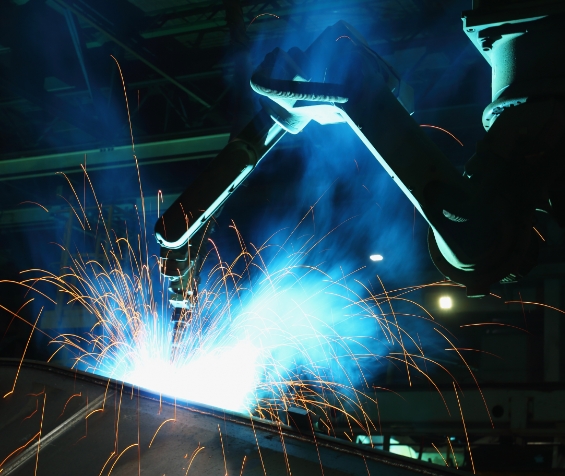
Robotic welding isn't plug-and-play. The manufacturers who struggle most aren't the ones who faced hard problems—they're the ones who didn't see them coming.
The welding market has changed significantly over the past decade. Robotic systems have become more capable, more accessible, and more varied in their applications, covering everything from simple repetitive tasks on high-volume lines to complex welds on precision components. That range is part of what makes robotic welding so valuable. It's also part of what makes choosing and implementing the right system more involved than it might appear.
Traditional robotic welding required significant infrastructure: dedicated cells, complex programming, and engineering teams to manage the robot controller and maintain weld parameters. Modern robotic technology has lowered those barriers considerably, but the fundamentals haven't changed. A robotic welder still needs to be matched to the right welding technique, configured for the specific weld joints involved, and integrated into a production environment that supports it.
Going in with a clear picture of what to expect lets your team plan for integration, prepare for the learning curve, and set realistic timelines. It also helps you ask better questions when evaluating automation partners. The goal isn't to create doubt; it's to replace it with a plan.
The 6 Biggest Robotic Welding Challenges — and How to Overcome Them
Every manufacturer's situation is different, but the six challenges below come up consistently across industries, facility sizes, and production types when they begin integrating welding robots and other automated welding machinery.
Here's what to expect and how experienced teams address each one.
1. High Upfront Investment and ROI Uncertainty
For many manufacturers, the first welding automation obstacle is financial. Robotic welding systems represent a significant capital investment, and without a clear picture of expected returns, it can be difficult to build the internal case for moving forward.
What Drives the Cost Concern
The sticker price is only part of the equation. Manufacturers often underestimate the full scope of implementation costs, including integration, programming, tooling, and ongoing maintenance for robotic welding machines. When those variables aren't accounted for upfront, ROI projections lose credibility quickly.
How to Build a Realistic ROI Case
The path forward is specificity. Rather than relying on general industry benchmarks, work with your automation partner to build a projection tied to your actual production volume, labor costs, scrap rates, and cycle time targets. A well-scoped system with clear performance parameters gives finance teams something concrete to evaluate.
Key inputs for a realistic robotic welding solutions ROI model include:
- Current labor costs per weld cycle: Understand the fully-loaded cost of manual welding, including overtime, turnover, and training.
- Scrap and rework rates: Quantify what inconsistent manual welding is already costing you in wasted material and time.
- Expected throughput increase: A qualified integrator can project cycle time improvements based on your specific parts and weld paths.
- Maintenance and consumables: Factor in ongoing costs so the projection reflects total cost of ownership, not just acquisition.
A clear-eyed ROI model turns a vague investment into a defensible business decision and sets a benchmark for measuring system performance after installation.
2. Integration with Existing Manual Welding Equipment and Workflows
Dropping a robotic welding system into an existing production environment is rarely straightforward. Most facilities weren't designed around automation, and making a new system work alongside legacy equipment, floor layouts, and established workflows takes careful planning.
Common Integration Friction Points
Space constraints, incompatible control systems, and undefined material flow are the most frequent sources of delay. When these aren't addressed before installation begins, they create costly disruptions on the shop floor.
Automate Welding Processes for the Environment You Have
The solution isn't to rebuild your facility around the machine. It's to design a machine around your facility. Custom-engineered systems that account for your footprint, your existing equipment, and your production flow integrate far more cleanly than off-the-shelf solutions retrofitted to fit.
Early collaboration between your team and the integrator's engineers is where most integration problems get solved. The more detail you share about your environment upfront, the fewer surprises appear at startup.
3. Programming Complexity and Changeover Time
Robotic welding systems are only as productive as their programming allows. In high-mix, low-volume environments, especially the time required to reprogram a system between jobs, can eat into the efficiency gains automation was supposed to deliver.
Modern robotic welding systems have addressed this significantly. Intuitive teach pendants, offline programming tools, and pre-built weld libraries reduce changeover time and lower the skill barrier for operators. But realizing those benefits requires a system designed with your production mix in mind from the start.
What Reduces Programming Burden and Technical Issues
- Offline programming capabilities: Allows engineers to develop and test weld paths without taking the system offline.
- Pre-qualified weld libraries: Reusable programs for common part geometries cut setup time on repeat jobs.
- Operator-level interfaces: Simplified controls let floor-level staff handle routine changeovers without engineering support.
- Custom tooling designed for your parts: Fixtures that locate parts consistently reduce the need to re-teach weld paths between runs.
When programming flexibility is built into the system design, changeover stops being a bottleneck and starts being a manageable part of the workflow.
4. Finding and Developing Operators Who Can Run the Automated Welding Systems
Robotic welding doesn't eliminate the need for skilled people. It changes what those people need to know. The transition from manual welding to automated welding supervision requires training, and for many facilities, that gap is wider than expected.
Why Human Welders are Still Crucial
Human welders bring adaptability and judgment that robotic systems are still working to replicate. The best implementations don't ignore that; they account for it. Manual welders often shift into supervisory and quality roles, overseeing welding tasks that robotic systems execute while applying their expertise where it matters most: fit-up, inspection, and handling the exceptions that fall outside the programmed path.
There's also a safety dimension worth acknowledging upfront. Hazardous environments (high heat, heavy fumes, confined spaces) are exactly where robotic welders add the most immediate value beyond productivity. Protecting the welding torch operator from sustained exposure to a punishing welding arc is a benefit that doesn't always show up in an ROI spreadsheet but matters to every plant manager responsible for workforce safety.
The Skills Gap in Robotic Welding Jobs
The manufacturing industry already faces a well-documented shortage of skilled welders. Layering automation into that environment can feel counterintuitive, but the reality is that cobots and robotic welding systems can extend the value of the experienced welders you already have if your team receives proper training.
Training as Part of the Integration Plan
Operator training shouldn't be an afterthought. The best integrators build training into the project scope, ensuring your team understands how to run, monitor, and perform basic maintenance on the system before it goes live. Ongoing support access (not just a manual and a phone number) is what separates a partner from a vendor.
5. Maintaining Weld Quality and Consistency Over Time
A robotic welding system that produces excellent welds on day one needs to be maintained to produce excellent welds on day five hundred. Over time, torch wear, fixture drift, and subtle calibration shifts can degrade weld quality in ways that aren't immediately obvious, until scrap rates rise or a quality audit surfaces the problem.
Consistent performance requires consistent monitoring. Scheduled audits that review torch condition, sensor calibration, fixture alignment, and system logs catch drift early, before it becomes defects. The goal is a predictive maintenance posture, not a reactive one.
6. Matching the Right System to the Right Application
Not every robotic welding system is suited to every application. Selecting the wrong system (one that doesn't account for part geometry, production volume, material type, or floor constraints) creates problems that no amount of fine-tuning will fully resolve.
What to Ask Before Selecting a Robotic Welding System
- What is the expected production volume? High-volume, single-part runs favor fixed robotic welding cells. High-mix, lower-volume environments may be better suited to cobot solutions.
- What materials and weld types are involved? MIG, TIG, laser welding, and resistance welding each have different system requirements.
- How much floor space is available? System footprint affects both the equipment configuration and how it interacts with surrounding workflow.
- What does future production look like? A system that fits today's needs but can't scale creates a ceiling on your ROI.
The right system isn't the most advanced one — it's the one engineered for what you actually produce.
The Right Partner Makes All the Difference: Melton Machine & Control Company
The challenges above aren't reasons to avoid robotic welding. They're reasons to choose your integration partner carefully.
With more than 55 years of experience and 1,000+ successful applications, Melton Machine & Control Company approaches every project as an engineering problem first. Our team doesn't recommend a system until we understand your production environment, your goals, and the constraints that matter to your operation. From initial assessment through installation and beyond, we stay involved to make sure the system performs the way it was designed to.
Every solution we build reflects the same principle: a solution that works for you because it was made for you. That means no off-the-shelf compromises, no oversized systems that exceed your needs, and no integration that ignores the realities of your floor.
If robotic welding is on your roadmap, let's talk through what the right solution actually looks like for your operation. Reach out to our team to start a conversation today.
Start a Conversation with the Melton Today
Consistency is the foundation of welding quality, and cobots are only as good as the systems that monitor and maintain them. Treating audits as a strategic investment, not a maintenance chore, ensures lasting productivity and a higher return on every automation asset.
Start a conversation with us to strengthen your cobot welding quality program and build a future defined by precision, reliability, and consistent excellence.