
When Does Robotic Welding Make Sense for Mid-Sized Manufacturers?
Many mid-sized manufacturers eventually reach a point where manual welding alone starts to limit growth. Production volumes increase, delivery timelines tighten, and maintaining consistent quality across multiple shifts becomes more challenging. At that stage, automation begins to move from a distant concept to a serious operational consideration. That's where robotic welding for mid-sized manufacturing comes in.
Robotic welding does not require massive production volumes or fully automated factories to deliver value. Instead, it becomes effective when certain operational conditions are present. Repetitive welds, stable product designs, labor constraints, and throughput bottlenecks often signal that welding robots can help stabilize production while supporting long-term scalability.
Below, we offer a few key considerations that can help you determine when robotic welding is the right next step for your operation.
Why More Companies are Considering Robotic Welding for Mid-Sized Manufacturing
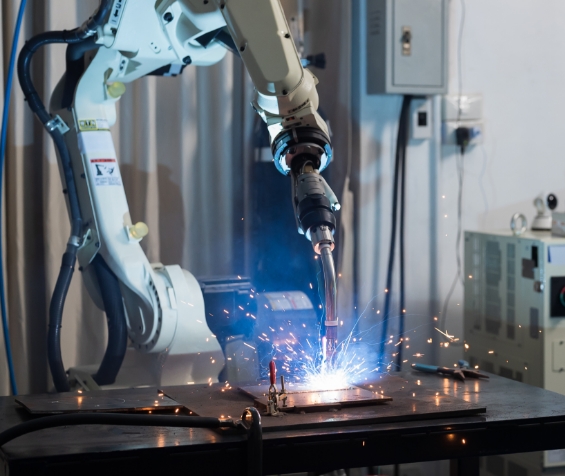
Several industry trends are pushing mid-sized manufacturers to evaluate robotic welding earlier than in the past. Here's why robotic welders are gaining ground fast:
The Manual Welding Bottleneck: Skilled Welder Shortages
One of the most significant pressures facing manufacturers today is the shortage of experienced welders. As veteran tradespeople retire, replacing those skills becomes increasingly difficult. Recruiting and training new welders takes time, and in many regions, the available labor pool is limited.
Automation allows manufacturers to maintain throughput even when hiring becomes challenging. Instead of replacing skilled workers, robotic welding supports them by handling repetitive welds while experienced personnel oversee programming, inspection, and process control.
Increasing Customer Quality Expectations
Customers expect consistent weld quality and reliable product performance. Even small variations between parts can lead to inspection failures, warranty claims, or delays in downstream assembly.
Robotic welding helps manufacturers maintain consistent weld parameters across production runs. By stabilizing the welding process, automated systems reduce variation and support predictable quality outcomes.
Pressure to Increase Throughput But Still Maintain Consistent Weld Quality
As demand increases, manual welding operations often become a production bottleneck. Welding is typically one of the most time-intensive steps in fabrication, and increasing throughput through manual labor alone may require significant hiring and training.
Robotic systems can operate continuously while maintaining stable weld quality, helping manufacturers expand production capacity without dramatically increasing headcount.
Competitive Pressure for Fast, High Quality Welds
Manufacturers operating in competitive markets must maintain both efficiency and consistency. Larger companies with automated systems often produce parts faster and with fewer defects.
For mid-sized operations, robotic welding can help maintain competitiveness by improving output stability while controlling production costs.
Signs Your Operation May Be Ready for Robotic Welding
Robotic welding becomes practical when certain production characteristics begin to appear within a manufacturing operation. These signals typically indicate that automation could stabilize production and support growth.
Common indicators that it's time for collaborative robots on your line:
- High volumes of repetitive welds: Long seams, recurring joint types, or repeatable weld patterns are ideal candidates for robotic automation.
- Stable product designs: Parts that remain consistent across multiple production runs allow robotic programs to be reused effectively.
- Difficulty hiring skilled welders: Automation can help maintain output when labor availability becomes a constraint.
- Production bottlenecks at welding stations: If welding consistently slows overall throughput, robotic systems may relieve the constraint.
- Quality variation between shifts: Differences in weld results between operators or shifts may indicate that tighter process control is needed.
- Growth projections that require additional capacity: When demand increases, but labor expansion is difficult, robotic welding provides a scalable solution.
Mid-sized manufacturers often assume automation requires extremely high production volumes. In reality, many robotic welding systems are justified by improving process stability and supporting moderate production growth.
When Robotic Welding May Not Be the Right Fit Yet
While robotic welding offers clear advantages, it's not ideal for every manufacturing environment. If you have a handful of the conditions below, it may not be time to focus on welding automation yet.
Extremely High Product Variation
Operations that focus primarily on one-off fabrication or constantly changing designs may struggle to justify robotic welding. Programming and fixturing become less efficient when parts rarely repeat. Melton has had success working with systems that handle these issues of variation. The systems can adapt to one-off fabrication, however the application solution comes at a higher cost and needs to be evaluated for Return on investment.
Very Low Production Volume
If welding tasks occur only occasionally, the investment in automation may not deliver sufficient return. In these environments, manual welding may remain the most practical solution. Melton does have customers who weld one part per day but have 3000 inches of weld. A robot can handle this easily. Again, the parameters need to be known to determine the feasibility of automation.
Poor Part Preparation or Fixturing
Robotic welding relies on consistent part positioning. If upstream processes produce inconsistent fit-up or alignment, robots may struggle to maintain weld accuracy. Great tools are becoming available to “find” seams,” make judgments on where to weld next, and “find” the proper weld path. AI will augment all of these tools in the near future.
Unstable Production Workflows
Automation works best when the surrounding manufacturing process is stable. Facilities with frequent changes in part design, materials, or workflow may need to address process stability before implementing robotic systems.
How Mid-Sized Manufacturers Typically Implement Robotic Welding
Many mid-sized manufacturers assume automation requires a complete transformation of their production line. In reality, most companies begin with a targeted approach, such as:
Starting With a Single Robotic Welding Cell
A common starting point is installing one robotic welding cell focused on a specific production bottleneck. Starting with one cell allows you to improve output in a critical area without restructuring the entire facility.
Once the system proves successful, additional automation can be integrated gradually.
Collaborative Welding Systems
Collaborative robots, or cobots, provide a flexible entry point into automation. These systems often require less floor space and can work alongside operators in shared environments.
For mid-sized manufacturers handling moderate batch sizes or mixed production, cobots can add capacity without requiring large-scale line redesigns.
Integrating Automation With Existing Workflows
Robotic welding systems frequently operate alongside manual welding stations. In many facilities, automation handles repetitive or high-volume welds while skilled welders focus on complex or variable work.
A hybrid approach allows manufacturers to improve productivity while preserving the expertise of their workforce.
Evaluating the Financial Case for Robotic Welding
While labor savings are part of the equation, the financial benefits of production-ready welding automation extend beyond workforce considerations. A properly selected welding system (including the right welding robot, stable welding torch setup, and controlled welding parameters) improves weld consistency and supports precise weld placement across every weld joint. The stability alone reduces rework and scrap when working with common materials such as carbon steel and other production metals.
Robotic systems also improve throughput and scheduling predictability. By maintaining consistent welding paths, wire feed rates, and shielding gas flow, automated systems stabilize cycle times for processes ranging from arc welding to spot welding and even specialized operations like laser welding.
Over time, predictable welding performance combined with offline programming, routine maintenance, and consistent process control provides measurable financial returns through increased productivity, reduced defects, and more efficient use of skilled labor across fabrication environments such as heavy equipment manufacturing.
Why Finding the Right Welding Robot Solution Doesn't Mean Eliminating Skilled Welders
Automation changes how welding expertise is applied within the production environment, but it doesn't eliminate the need for it.
In many automated facilities, skilled welders take on expanded responsibilities that include developing welding paths through offline programming, validating welding parameters, and ensuring the welding torch and process configuration match the requirements of each weld joint. Their understanding of metallurgy, shielding gas behavior, and arc welding fundamentals remains essential to maintaining consistent weld quality across production runs.
Rather than replacing skilled tradespeople, robotic welding allows them to focus on higher-value tasks such as process optimization, inspection, and troubleshooting complex weld conditions. Whether monitoring spot welding processes, adjusting wire feed settings, or verifying precise weld placement on carbon steel assemblies used in heavy equipment production, their experience ensures the system performs reliably.
Is Robotic Welding the Next Step for Your Operation? Melton Machine & Control Company Can Help
For mid-sized manufacturers, robotic welding becomes practical when production conditions support automation. Repetitive welds, stable product designs, labor constraints, and throughput limitations often signal that robotic systems could provide meaningful benefits.
When implemented thoughtfully, robotic welding helps stabilize production, improve consistency, and support long-term growth.
With more than 55 years of experience designing and integrating robotic welding systems, Melton works with manufacturers to develop automation solutions tailored to their production needs.
If you're evaluating whether robotic welding fits your operation, start a conversation with us today to explore a solution designed around your manufacturing goals.
Start a Conversation with the Melton Today
Consistency is the foundation of welding quality, and cobots are only as good as the systems that monitor and maintain them. Treating audits as a strategic investment, not a maintenance chore, ensures lasting productivity and a higher return on every automation asset.
Start a conversation with us to strengthen your cobot welding quality program and build a future defined by precision, reliability, and consistent excellence.