Robotics and Automation for Military Manufacturing
Modern military manufacturing operates under conditions that leave little room for error. Components must perform in extreme environments, endure heavy stress, and meet strict military specifications without compromise. Every weld, assembly, inspection point, and material transfer step must align with documented standards and traceability requirements.
Unlike many commercial sectors, defense production demands consistency over long lifecycles. Programs often run for years or decades, requiring stable processes that maintain accuracy from the first production run to the last. At the same time, manufacturers face labor shortages, increasing documentation demands, and pressure to improve throughput without sacrificing compliance.
Robotics and automation provide a structured way to stabilize production, reduce variability, and support the precision required in military environments. Melton Machine & Control Company brings over 55 years of experience designing and building custom solutions for automation in military manufacturing.
Why Automation Is Critical for Defense Industry Manufacturing Capabilities
Defense manufacturing operates at the intersection of engineering precision and national security. Unlike purely commercial sectors, the defense industry supports weapons systems, military aircraft, ground vehicles, and critical infrastructure that must perform without failure under extreme conditions.
Today’s defense procurement environment is shaped not only by performance expectations but also by traceability requirements tied to international arms transfers, the global arms trade, and increasingly complex arms sales agreements that often extend to allied nations in regions such as the Middle East.
Here are a few of the ways automation in military manufacturing can help in such a complex environment.
Zero-Defect Expectations Across the Supply Chain
Defense components often serve structural or mission-critical roles. Weld integrity, dimensional accuracy, and material consistency must meet exact tolerances. Even minor variations can lead to costly rework, failed inspections, or rejected batches.
Robotic systems deliver controlled motion, consistent weld parameters, and repeatable positioning. This level of precision reduces process drift and supports high-confidence production across extended runs.
Skilled Labor Constraints
Military-grade welding and fabrication require certified, experienced personnel. As skilled tradespeople retire and recruitment becomes more difficult, manufacturers must maintain output with smaller teams.
Automation does not replace skilled welders or technicians. Instead, it supports them by handling repetitive or physically demanding operations while allowing experienced personnel to oversee process control, inspection, and specialized tasks.
Industrial Base Compliance and Traceability Requirements
Defense contracts frequently require documented process validation and inspection records. Traceability is not optional; it is foundational.
Automated systems with integrated monitoring and data capture capabilities support consistent documentation. Weld parameters, torque values, dimensional measurements, and inspection results can be recorded and reviewed, strengthening audit readiness and compliance confidence.
Heavy and Complex Components In Advanced Manufacturing
Military manufacturing often involves reinforced structures, heavy-gauge materials, armored assemblies, and complex subcomponents. These parts can be difficult to handle safely and consistently with manual processes alone.
Material handling automation and coordinated robotic positioning systems reduce strain on operators while improving repeatable part alignment. This ensures that large or high-value components are handled with stability and precision throughout production.
Bottom line? Military manufacturing is about much more than speed. Manufacturers need control, documentation, and repeatable execution under demanding standards, and that's exactly where automation can help.
Automation Solutions for Military Manufacturing, Arms Production, and Defense Technology
Defense production facilities require automation that supports fabrication, assembly, inspection, and handling under strict standards. Melton provides integrated solutions tailored to these needs.
Automated manufacturing solutions for the defense industrial base include:
Robotic Welding Systems
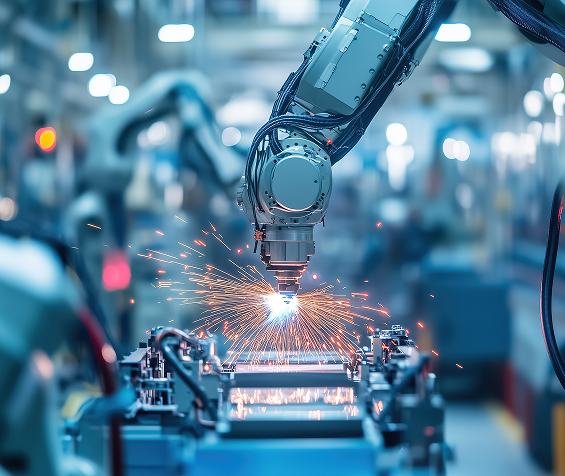
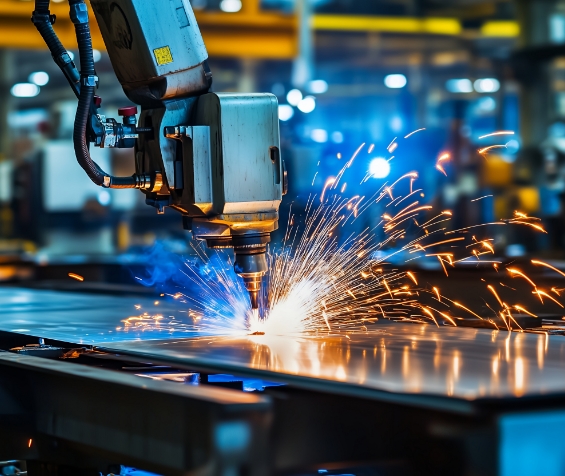
Military components often require deep penetration welds, multi-pass welding sequences, and consistent bead geometry across heavy materials. Our robotic welding systems incorporate coordinated positioners, adaptive programming, and controlled parameter management to maintain structural integrity and repeatability.
Whether producing reinforced frames, structural housings, or complex assemblies, robotic welding supports stable, documented weld performance.
Robotic Quality Control
Inspection is critical in military manufacturing. Automated quality control stations can verify dimensional accuracy, weld consistency, and part alignment using integrated sensors and measurement tools. These systems reduce reliance on subjective inspection while supporting documented quality assurance processes.
By embedding inspection into the production line, manufacturers reduce bottlenecks and strengthen compliance.
Material Handling Automation
Large or sensitive components require careful movement between workstations. Automated material handling systems (including robotic transfer arms, gantry systems, and coordinated positioners) improve part stability while reducing operator strain.
Consistent part presentation enhances downstream welding and assembly accuracy, minimizing rework.
Robotic Assembly Systems
Defense assemblies often include precision fasteners, bushings, torque-sensitive components, and alignment-critical subassemblies. Robotic assembly systems incorporate torque verification, force monitoring, and error-proofing logic to maintain consistent build quality.
Robotic Laser Systems
For applications requiring high-precision cutting or permanent marking, robotic laser systems deliver clean edges and consistent traceability. Laser marking supports serialized identification and compliance tracking without introducing mechanical stress to the part.
Contract/Build-to-Print Solutions
Many defense contractors operate under tightly controlled specifications. Our contract and build-to-print capabilities allow us to manufacture and integrate systems based on customer-supplied drawings, bills of materials, and control programming.
This flexibility supports contractors who require controlled builds within defined technical frameworks.
Why Choose Melton for Military Automation Projects?
Military manufacturing requires more than equipment. It requires engineering discipline, secure project execution, and long-term reliability.
For more than 55 years, Melton Machine & Control Company has designed and integrated custom automation systems across highly regulated industries. With more than 1,000 successful applications installed, our experience spans complex welding, assembly, inspection, and material handling environments.
Every system we build is engineered around your parts, materials, and facility constraints. We do not force standardized cells into specialized environments. Instead, we evaluate your workflow, risk factors, and compliance requirements to design a solution aligned with your operational goals.
Our in-house engineering team manages system design, programming, integration, and startup. Whether developing a fully integrated robotic system or executing a build-to-print project based on customer-supplied specifications, we prioritize reliability, safety, and long-term support.
Military production environments demand stability. Our systems are designed to deliver it.
The Strategic Advantage of Defense and Arms Industry Automation
In military manufacturing, much of automation's appeal is also about reducing risk.
Robotic systems stabilize production by minimizing variation. Integrated inspection strengthens compliance. Material handling automation reduces safety exposure. Controlled welding and assembly processes maintain structural integrity across long production cycles.
All of these benefits compound over time. Reduced rework, improved documentation, and predictable cycle times support operational resilience. As defense programs expand or evolve, automated systems provide the foundation for scalable production without sacrificing quality standards.
Automation, when engineered correctly, becomes a risk mitigation tool as much as a productivity tool.
Melton: Your Trusted Partner for High-Stakes Military Equipment Manufacturing
At Melton Machine & Control Company, we approach every project with those priorities in mind. If you're interested in robotic welding systems, integrated inspection, material handling automation, or other solutions, we're here to help. All of our solutions are engineered around your production requirements.
Start a conversation today to explore a solution designed around your operational and compliance goals.