Manufacturing Automation Solutions for the Education Industry
Many institutions in the education industry still rely on outdated equipment or limited training tools that do not reflect current industry practices. This creates a gap between what students learn and what they are expected to do on the job. Robotics and other manufacturing automation tools provide a practical way to close that gap by bringing real systems into the learning environment.
Melton Machine & Control Company designs and builds custom automation solutions that support hands-on training, lab development, and applied learning. With more than 55 years of experience, our team works with educational institutions to create systems that reflect how automation is actually used in modern production environments.
Why Automation Matters in Modern Education and Workforce Training
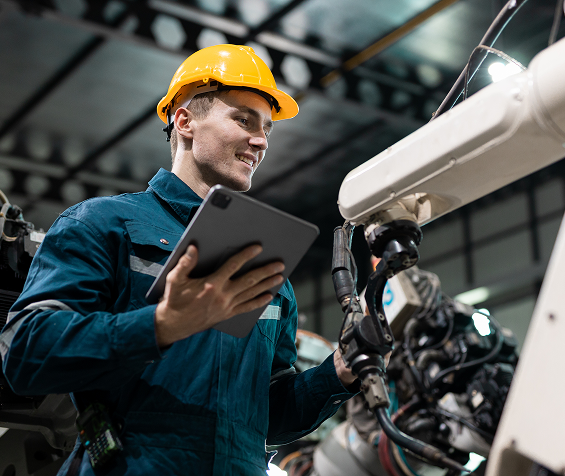
Educational institutions are increasingly expected to produce graduates who can contribute immediately in technical roles. The challenge is not access to information, but access to applied experience. Students need opportunities to interact with the same types of systems they will encounter in the field.
The Gap Between Classroom Learning and Industrial Reality
Many programs provide a strong theoretical foundation but limited exposure to real automation systems. As a result, students may understand concepts like robotic motion or welding parameters without having worked directly with a robotic cell.
This gap can make the transition into the workforce more difficult. Employers often expect familiarity with system setup, troubleshooting, and basic programming, not just conceptual understanding.
Outdated or Limited Training Equipment
In some cases, training environments rely on equipment that no longer reflects current industry standards. Legacy systems may lack integration, flexibility, or the ability to demonstrate how different processes interact within a production workflow.
Modern automation environments combine welding, material handling, inspection, and controls into unified systems. Without access to this level of integration, students miss an important part of how manufacturing actually operates.
Demand for Skilled, Job-Ready Graduates
Across the manufacturing sector, there is ongoing demand for individuals who understand both manual processes and automated systems. This includes welders who can work with robotic systems, technicians who can support automation equipment, and operators who can navigate integrated production environments.
Programs that incorporate hands-on automation are better positioned to align with these expectations and support workforce development goals.
The Need for Flexible, Multi-Use Lab Environments
Education and training spaces must serve multiple purposes. A single lab may support introductory instruction, advanced coursework, demonstrations, and research activities.
Automation systems in these environments need to be flexible and adaptable. Rather than being designed for a single task, they should support a range of learning scenarios while remaining accessible to students and instructors.
Automation in education is ultimately about creating environments where students can interact with real systems, not simulations.
Implementing Automation Solutions for Education, Training Labs, and Research Programs
Educational automation systems must balance functionality, safety, and accessibility. They need to demonstrate real-world processes while remaining suitable for instructional use. Melton designs systems that support hands-on learning across a variety of programs and applications, including:
Robotic Welding Training Cells
Robotic welding systems provide students with direct exposure to one of the most widely used automation applications in manufacturing. In a training environment, these systems can be used to teach programming fundamentals, weld parameter control, and system setup.
Students can observe how changes in settings affect weld quality and consistency, gaining a deeper understanding of the process. In more advanced environments, these systems may also support exploration of emerging applications, such as integrating welding processes with additive or hybrid techniques.
Cobot Systems for Interactive Learning
Collaborative robots are particularly well-suited for educational environments because they are designed to operate in closer proximity to people. Their programming interfaces are often more intuitive, making them accessible to students who are new to automation.
Cobot systems can be used to demonstrate a wide range of tasks, from welding and material handling to light assembly and machine tending. This flexibility allows programs to introduce automation concepts without requiring a full production-style setup.
Material Handling and System Integration Demonstrations
Understanding how parts move through a system is an important part of learning automation. Material handling systems allow students to see how components are transferred, positioned, and prepared for downstream processes.
By integrating multiple elements into a single cell, these systems demonstrate how automation functions as a coordinated workflow rather than a collection of isolated machines.
Robotic Quality Control and Inspection Systems
Inspection and validation are essential components of any manufacturing process. In an educational setting, robotic quality control systems can be used to demonstrate measurement techniques, inspection criteria, and the role of data in maintaining consistency.
Students gain exposure to tools and methods that support repeatability and verification, helping them understand how quality is maintained in automated environments.
Build-to-Print and Custom Training Systems
Many educational institutions operate with defined program requirements, whether driven by curriculum goals, grant funding, or research initiatives. In these cases, flexibility in system design is critical.
Melton’s build-to-print capabilities allow us to work from customer-supplied specifications, drawings, and program requirements. This collaborative approach ensures that the resulting system aligns with the intended use, whether for instruction, demonstration, or research.
Why Choose Melton for Education and Training Automation Projects?
Educational environments require a different approach than production facilities. Systems must be functional and accurate, but also accessible, adaptable, and aligned with how students learn.
Melton approaches these projects as engineering challenges shaped by the needs of the institution. Rather than applying a standard solution, we design systems around your space, your program objectives, and your long-term plans.
Our team works closely with instructors, program leads, and facility stakeholders to understand how the system will be used. This includes considerations such as student interaction, safety requirements, and the ability to support multiple types of instruction within the same environment.
With decades of experience integrating complex automation systems, we bring a level of reliability and technical depth that supports both foundational training and more advanced applications. Our in-house engineering team manages design, programming, integration, and startup, ensuring that each system functions as intended from the outset.
Supporting Advanced Research and Emerging Applications with Manufacturing Automation Tools
In addition to teaching, many institutions are expanding their focus to include applied research that reflects real-world manufacturing environments. These environments often involve studying production processes, evaluating automated processes, and understanding how different systems behave under varying conditions. For this reason, automation systems used in research settings must support experimentation while maintaining consistent quality and repeatability.
Robotic platforms equipped with industrial robots, programmable logic controllers, and computer numerical control interfaces provide a foundation for exploring how modern automated production lines operate. In some cases, this includes examining how flexible automation compares to fixed automation, or how programmable automation can be adapted across different applications, such as batch production or specialized workflows. Advanced labs may also incorporate artificial intelligence or other advanced technology to study how systems can adapt and improve over time.
The goal in these environments is not to prescribe a specific outcome, but to create a controlled, well-designed platform that supports investigation. By integrating automation with existing systems, institutions can build research environments that reflect how automation is actually implemented, while allowing students and faculty to explore new approaches to system design and performance.

The Strategic Value of Automation in the Education Industry
Automation in education is not about increasing output or replacing labor. It is about preparing individuals to operate effectively within modern manufacturing environments, where automated processes, digital controls, and system integration are standard expectations. Exposure to these systems helps students understand how implementing automation affects production line behavior, workflow coordination, and overall system performance.
Hands-on interaction with automation allows students to see how industrial robots, control systems, and integrated technologies work together to reduce human error, enhance efficiency, and improve consistency. The experience provides insight into how automation enables manufacturers to achieve improved efficiency, stabilize operations, and reduce operational costs over time.
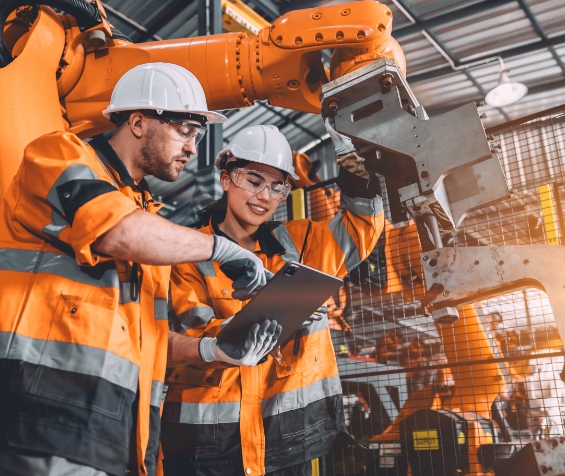
By incorporating automation into training environments, institutions create a direct connection between education and real-world application. Students gain practical experience with the tools and systems they will encounter in the field, while programs remain aligned with evolving industry expectations. In this way, automation supports workforce development by preparing individuals to contribute effectively in environments where precision, coordination, and adaptability are critical.
Melton: Your Partner for Advanced Technology in Education, Training, and Workforce Development
For more than 55 years, Melton has designed and integrated custom automation systems across a wide range of industries. That experience translates directly into education and training environments where reliability, flexibility, and long-term usability are critical.
We approach each project as a collaboration, working to understand your goals and build a system that supports them. If you are planning an automation lab, training environment, or research system, start a conversation today, and we'll help design a solution aligned with your program goals.