
Robotic Aluminum Welding: Challenges and How to Get Consistent Results
Aluminum is lightweight, strong for its weight, and corrosion-resistant, which is why manufacturers rely on it for everything from HVAC components to piping to non-conductive products to warehouse equipment. It is also one of the less forgiving metals to weld. A process that runs smoothly while welding steel can produce porosity, burn-through, and erratic wire feeding on aluminum.
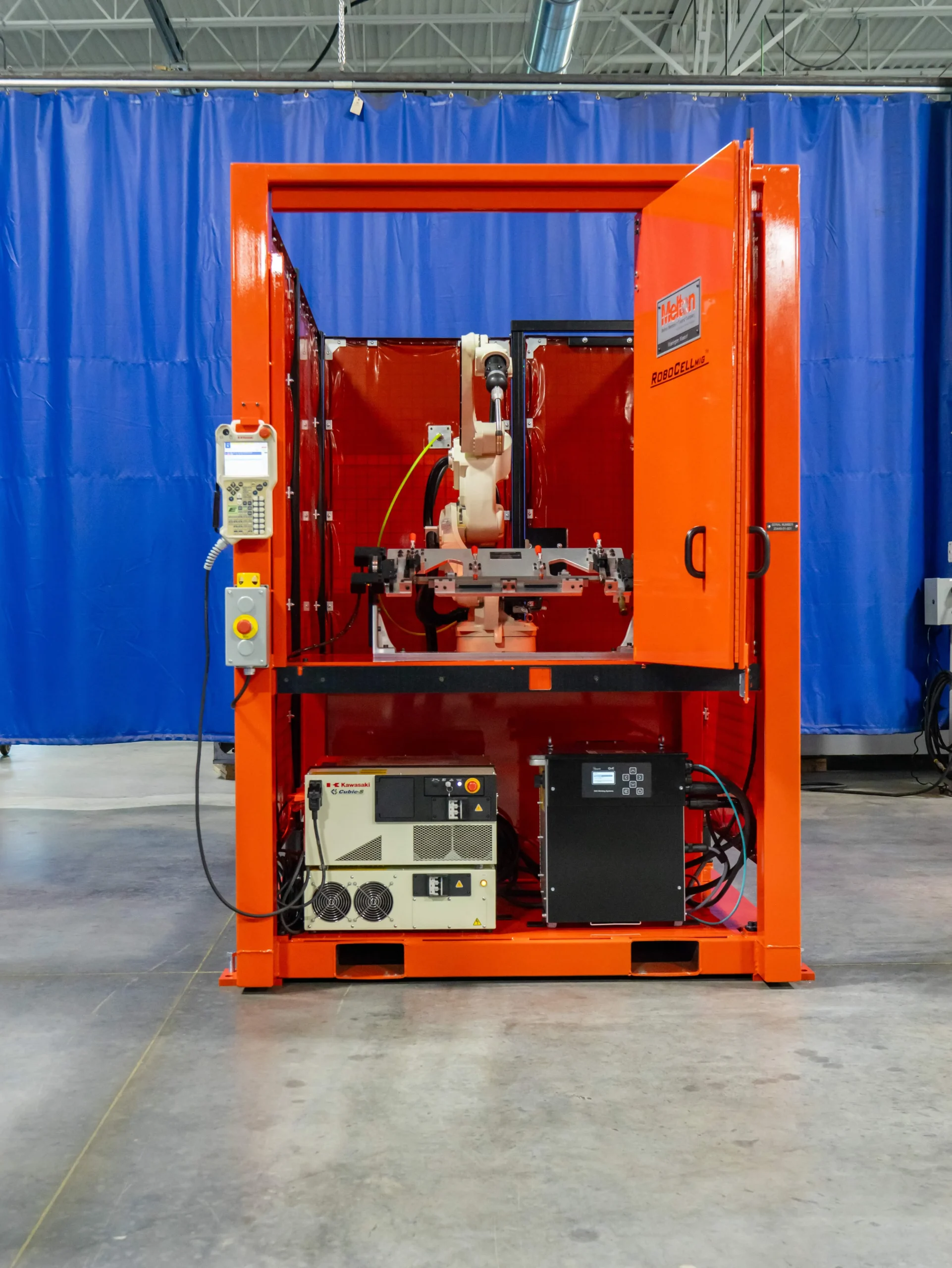
Automated welding gives manufacturers a way to control those variables. A robot holds travel speed, torch angle, and arc length steady on every part. But the robot is only one piece of the puzzle. Consistent results also depend on surface prep, fixturing, wire delivery, and the right welding process.
Why Is Aluminum Harder to Weld Than Steel?
Three properties cause most of the trouble: a tough oxide layer, high thermal conductivity, and soft wire. Aluminum also melts at a lower temperature than steel. Unlike other metals, the welding of aluminum calls for special considerations and specialized knowledge at every step.
How Aluminum Oxide Leads to Weld Defects
Aluminum forms a thin aluminum oxide layer almost as soon as it meets air. That layer melts near 3,700°F, so it needs more heat than the aluminum base metal, which has a low melting point of roughly 1,200°F. Oxide trapped in the weld puddle causes lack of fusion and porosity, which can ultimately compromise the final weld’s integrity. Moisture and oils add hydrogen to molten material, creating more gas bubbles.
Prep is the answer:
- Degrease first: Remove oils and lubricants with an appropriate solvent.
- Remove oxide mechanically: Use a stainless steel brush dedicated to aluminum so you don’t transfer contaminants.
- Weld soon after cleaning: Oxide begins to re-form right away, so long gaps between cleaning and welding undo your work.
Taking these steps ensures that the aluminum oxide layer will not negatively affect your weld.
Heat Conductivity and Burn-Through
Aluminum’s thermal conductivity is about four times that of steel, so heat leaves the weld zone fast. Thicker sections need higher amperage and enough heat for proper penetration, yet thin base material can burn through in an instant because aluminum doesn’t glow or change color before it melts. Thermal expansion adds distortion, and aluminum’s fast solidification can lead to hot cracks along the weld seam.
Heat management is where robots excel. Heat input can be programmed by segment, travel speed stays constant, and the robot performs the same crater fill every time. Advanced software allows precise heat input throughout the weld.
Wire Feeding Problems With Soft Aluminum Wire
Aluminum welding wire is soft, so it can kink, shave, or buckle inside the liner. The usual symptoms are birdnesting at the drive rolls, burnback at the contact tip, and shavings that cause inconsistent feeding.
A robot cannot compensate for an unstable wire feed, so wire delivery must be right from the start. Push-pull wire feeding systems maintain wire tension for soft aluminum and are ideal for robotic aluminum welding. U-groove drive rolls set to a light-tension grip without shaving, and plastic or Teflon liners reduce friction. Match filler metal and wire diameter to the alloy, and pair them with a dependable wire feeder and contact tips that allow for expansion. A short, smooth cable path with gentle bends keeps an aluminum MIG welding robot feeding consistently through its full range of motion.
Why Does Pulse MIG Work Well for Aluminum?
Metal inert gas welding, or MIG, is the usual process for automated aluminum welding, generally on material from about 14 to 18 gauge and up. Pulse MIG alternates between a high peak current and a low background current. Each peak releases one droplet, and the background period lets the weld puddle cool. Cold Metal Transfer variants reduce heat input even further. For aluminum, that has real benefits:
- Burn-Through Prevention: Lower heat input reduces the risk of melting through thin material.
- Reduced Distortion: Less heat means less warping as the aluminum expands.
- Cleaner Droplet Transfer: One droplet per pulse means less spatter.
- Out-of-Position Control: A cooler weld puddle eases vertical and overhead welds.
Gas coverage matters too. Pure argon, an inert gas, is common, and argon-helium blends add heat on thicker sections.
Other Aluminum Welding Processes
Gas tungsten inert gas arc welding, or TIG welding, uses a non-melting tungsten electrode and alternating current with square wave output to break up the oxide, which suits thin or cosmetic work. TIG is used in applications where cosmetics are important. Frequently, TIG is used for repair of a faulty weld or to limit the heat input to the base part, minimizing distortion. The big tradeoff between Pulsed MIG and TIG with cold wire feed is speed. Pulsed MIG is faster than TIG with cold wire feed (although with robotics, TIG’s speed can be only 15% slower than pulsed MIG). Marketplace trends are leading toward pulsed MIG.
Laser welding offers high speed and low thermal distortion, and it stabilizes the molten pool to prevent porosity. Both MIG and TIG welding can be automated, and arc welding robots with advanced controls repeat arc start and parameters without drift.
Fixture, Sensor, and Cleaning Prep
A robot follows the path it was taught, so if a part sits slightly out of position, the torch can miss the joint. That is a fixture problem, not a robot problem. Good fixtures and tooling for aluminum locate parts repeatedly so the torch meets the seam in the same spot every cycle, and they clamp firmly to resist distortion as the metal expands. They also manage heat with backing bars or heat-sinking materials where needed, and they leave clear access for the torch, cable, and wire paths.
Sensors add another layer of control. Vision sensors improve joint recognition and alignment, and real-time seam tracking adjusts the weld path during operation. AI-driven monitoring can also flag process deviations early, which helps reduce rework.
Cleaning belongs in the process, not just on an operator’s checklist. Define how parts are degreased, brushed, and staged, and how long they can wait before welding. Maintenance on liners, contact tips, and drive rolls deserves the same attention. Automated inspection after welding can also catch porosity early, before parts move downstream.
How Automated Aluminum Welding Delivers Consistent Results
Automated aluminum welding and broader welding automation work best when the whole welding system is designed together. A mismatch in any one piece shows up as a defect.
Designing the System as a Whole
A pulse MIG power source can’t fix a stuttering feed, and a precise robot can’t fix a fixture that lets the part shift. When the robot, equipment, fixtures, sensors, and prep are engineered together, each supports the rest.
Repeatable Quality and Less Rework
Robotic welding improves weld consistency and repeatability from the first part to the thousandth part. Precise control means steadier quality and fewer rejected parts.
Addressing the Skilled Labor Gap
Experienced aluminum welders and programming expertise are both hard to find. Robotic welding systems take on repetitive welding tasks with proven parameters built in. Robots operate without fatigue, reach difficult weld locations with precision, and reduce manual strain and exposure to hazards, which improves workplace safety.
Choosing the Right Automation Partner
Welding applications for aluminum vary by part size, alloy, and volume. The right industrial robot, whether a traditional arm such as Fanuc robots or a collaborative robot, depends on the job, and laser welding or spot welding may fit some parts. An integrator that studies your parts and designs a custom cell will deliver automation solutions that fit your needs.
About Melton Machine & Control Company
For more than 55 years, Melton Machine & Control Company has helped manufacturers improve productivity and quality through custom automation.
If aluminum is creating weld quality or throughput challenges in your operation, automation may be the next step. Melton’s experts can review your parts, process, and goals to determine whether robotic aluminum welding is the right fit.