

Challenges in EV Component Manufacturing and How Automation Helps
Growing demand for electric vehicles (EVs) is creating new opportunities for component manufacturers, but it's also placing greater pressure on them to adjust their operations. Today, EV component manufacturers are being challenged to increase production capacity while also maintaining strict quality standards and adapting to rapidly evolving vehicle designs.
Automation gives EV component manufacturers a practical way to stay competitive. Robotics and advanced manufacturing systems allow them to increase throughput, improve production consistency, and support the flexibility required to adapt as vehicle platforms evolve. Melton Machine & Control Company partners with EV manufacturers to design and install the automation solutions they need to assemble battery systems, weld aluminum, or handle delicate electronic components.
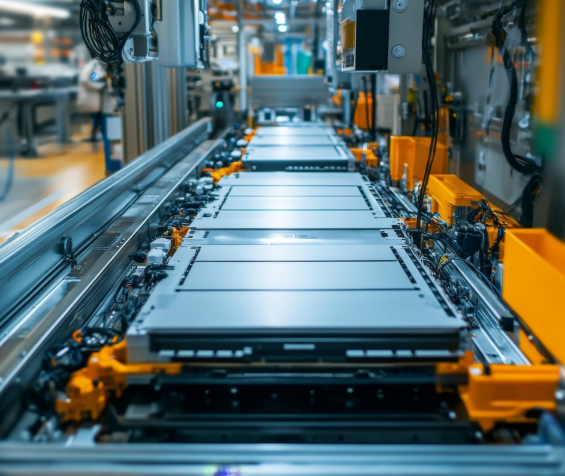
Core Challenges Facing EV Component Manufacturing
Electric car manufacturing requires greater precision, flexibility, and process control than traditional automotive production. The vehicles' advanced components and assemblies, combined with the increased use of lightweight materials, demand different production and handling methods. These requirements create unique challenges throughout the manufacturing process.
1. Safe and Precise Handling of EV Batteries
Battery systems are the heart of electric vehicles, and battery technology is growing in size and complexity. Lithium-ion battery cells are sensitive to impact, pressure, contamination, and misalignment, which can negatively affect EV battery performance and lifespan or create safety concerns. During battery production, using manual handling processes can increase the risk of damage. Automated handling systems, however, reduce this risk by enabling manufacturers to safely move, position, and assemble these critical components.
2. Manufacturing with Lightweight Materials
To improve efficiency and extend driving range, EV engineers continue to specify more lightweight materials such as aluminum and advanced composites in their designs. These materials offer performance advantages, but they often require production methods that differ significantly from those used in traditional automotive manufacturing.
For example, traditional welding and fastening techniques can introduce heat distortion, inconsistent joints, or weakened structures when applied to lightweight components. Precision joining processes and automation solutions can help manufacturers successfully maintain dimensional accuracy and preserve material strength.
3. Managing Complex Assembly Requirements
Electric vehicles combine mechanical systems with advanced electronics in ways that create more demanding assembly environments. Battery trays and cells, electric motors, high-voltage wiring, sensors, and control systems must all work together within increasingly compact designs.
Higher assembly complexity increases the need for repeatability and accuracy in every production step. Small inconsistencies often create downstream defects, rework, production delays, and ultimately, higher costs. Manufacturers need processes that ensure components are assembled correctly the first time, and often they need to do so across multiple production lines.
4. Scaling Production to Meet Demand for Electric Vehicles Manufacturing
As consumer interest and adoption of electric vehicles grow, production systems are under growing pressure to deliver greater output without sacrificing quality. Production lines must support faster ramp-ups, shorter launch windows, and more frequent design updates as vehicle manufacturers continue to introduce new EV models and enhance design specifications for existing vehicles.
Traditional manufacturing systems often struggle to keep pace with these changing requirements. Flexible automation solutions help manufacturers rapidly changeover to a different part and maintain consistent performance even as production volumes increase.
5. Navigating Labor, Cost, and Supply Chain Pressures in the EV Industry
EV manufacturers in the automotive industry are also balancing broader operational challenges that extend beyond the production floor. Skilled labor shortages, along with rising material and operating costs, are increasing pressure on manufacturers to do more with less. At the same time, hiccups in global supply chains and new tariffs have made the manufacturing environment even more complex and require manufacturers to better coordinate with suppliers to avoid production stoppages.
EV Component Manufacturing Automation Scales Production
Automation helps EV component manufacturers address these challenges and scale production to meet the growing demand. Automated systems support higher volumes while creating more stable, repeatable operations across the manufacturing operation.
Material Handling Automation Protects Critical EV Components
Automated material handling solutions enable safe, reliable movement of critical components throughout the EV manufacturing processes. Conveyors, gantries, and robotic systems reduce manual handling and minimize unnecessary contact with battery packs, sensitive electronics, and precision assemblies. In addition to protecting sensitive parts, manufacturers can lower workplace risk and maintain product quality at scale.
Robotic Welding Systems Improve Precision and Throughput
Lightweight EV components and mixed-material assemblies require joining methods that deliver strength without introducing distortion or inconsistency. Robotic welding systems increase production speed and provide highly controlled, repeatable processes that improve weld quality. Automation also reduces operator fatigue and creates more stable cycle times, helping manufacturers maintain output targets. All of this leads to the production of components that meet strict safety and performance requirements.
Automated Assembly Systems Increase Flexibility
As EV platforms continue to evolve, manufacturers need production systems that can adapt quickly without sacrificing efficiency. Fully automated and semi-automated assembly solutions improve repeatability and production speed. They also enable manufacturers to be more flexible and quickly complete changeovers to begin producing parts for different vehicle designs.
Custom Fixtures and Tooling Support Accuracy
Stable positioning and repeatable processes lead to consistent part production. Custom fixtures and tooling ensure accurate positioning and alignment throughout assembly and machining operations. When paired with automation and high-precision machining capabilities, properly engineered tooling improves efficiency and reduces variation. Achieving consistent output even as component geometries become more complex improves profitability by minimizing expensive and time-consuming rework.
Robotic Laser Systems Enable High-Precision EV Manufacturing
Many EV applications, such as battery housings, structural components, interior assemblies, and precision cutting operations, are best handled with robotic laser technology. These systems support high-precision manufacturing by reducing thermal distortion and producing clean, repeatable results. The combination of speed and precision allows manufacturers to improve quality and maintain throughput in demanding EV production environments.
Automation Quality Control Solutions Reduce Defects
Quality control is a critical part of every operation in EV manufacturing. Automated inspection systems use vision technology, sensors, and laser measurement tools to identify issues early in the production process before they lead to failures further down the line. Automated solutions for quality control processes can move manufacturers closer to zero-defect production goals by improving traceability, reducing rework, and supporting long-term operational performance.
Why Work with Melton for EV Manufacturing Automation
Choosing the right automation partner can make the difference between simply increasing output and building a manufacturing operation that is ready to capitalize on the current growth trajectory in the EV market. With more than 55 years of automation expertise, Melton brings deep technical knowledge and proven experience supporting the high-volume, high-precision demands of EV automotive manufacturing. As a 100% employee-owned company, we take a hands-on, customer-focused approach to engineering, developing solutions that are aligned with each customer’s goals and invested in long-term performance. Rather than offering one-size-fits-all systems, Melton designs custom automation systems around your specific parts, production processes, and throughput requirements, to help you improve consistency, increase efficiency, and adapt as EV technologies continue to evolve.
Powering the Next Generation of EV Manufacturing
The rapid growth of market demand for electric vehicles is creating significant opportunities for component manufacturers to expand EV production capabilities, increase capacity, and support the future of automotive innovation, but it also introduces new levels of complexity. If you’re evaluating how to optimize production or prepare your operation for the next generation of EV manufacturing, now is the time to assess whether your current processes are built to scale. Our team can evaluate your existing assembly process, identify opportunities to add EV component manufacturing automation, and recommend solutions tailored to your needs.