
Common Welding Bottlenecks—and How Robotic Welding Systems Solve Them
Every manufacturing operation has a constraint: a point in the production process where work slows, backs up, or breaks down. For a significant number of fabricators and manufacturers, that constraint lives in the welding process.
Welding bottlenecks are expensive. They delay downstream processes, compress delivery timelines, and force manufacturers to choose between overtime costs and missed commitments. What makes them particularly frustrating is that they're often treated as fixed: an unavoidable function of skilled labor availability, production volume, or facility capacity.
They aren't fixed. The robotic welding system benefits that manufacturers across industries have captured over the past decade make that clear. This guide identifies the most common welding bottlenecks in manufacturing, explains what causes them, and shows how welding automation solutions address each one.
Why Welding Is Where Manufacturing Bottlenecks Concentrate
Welding sits near the center of most fabrication workflows, downstream from raw materials and forming operations, upstream from finishing, assembly, and shipping. That position means welding is a throughput gate. When bottlenecks occur here, everything behind them queues. Finished goods back up into excess inventory. Delivery windows compress against customer demand. Downstream labor sits idle waiting for parts that haven't cleared the weld cell.
Manufacturers serious about production efficiency often turn to value stream mapping to identify potential bottlenecks across their operation, and welding surfaces as the constraint more often than most. It's a predictable finding. The combination of skilled labor dependency, product quality requirements, and the physical demands of the work makes welding one of the most vulnerable points in the production process.
That central position is also why a thorough bottleneck analysis of the welding operation pays dividends across the entire line. Continuous improvement efforts that target the constraint, rather than optimizing around it, improve throughput everywhere downstream.
The 5 Most Common Welding Bottlenecks in Manufacturing
These bottlenecks appear across industries and facility sizes. Most manufacturers are dealing with more than one simultaneously.
1. Labor Shortages and Workforce Instability
The skilled welder shortage isn't a future problem; it's a present one. Experienced welders are retiring faster than the pipeline can replace them, and competition for qualified candidates is intense across virtually every manufacturing sector. The result is chronic understaffing, escalating wages, and production plans built around workforce headcounts that never quite materialize.
How Labor Shortages Create Downstream Problems
Understaffed welding operations don't just produce less. They also produce unpredictably. When throughput depends on how many welders show up on a given day, production planning becomes guesswork. Delivery commitments made on full-crew assumptions get missed when attendance falls short. Overtime fills some of the gap, but it adds cost, accelerates fatigue, and isn't a sustainable answer to a structural workforce problem.
How Automated Welding Addresses It
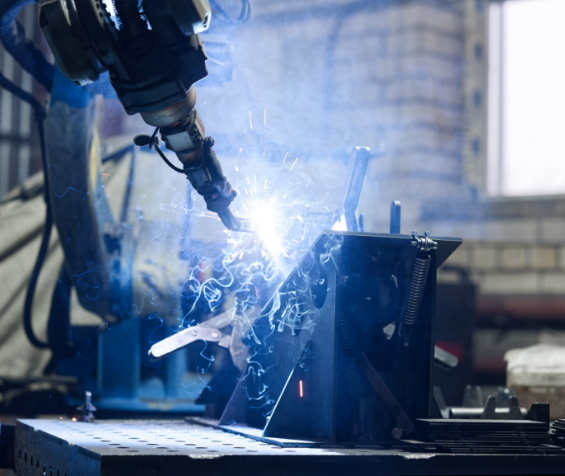
Robotic welding systems decouple production capacity from headcount. A robotic welding cell or automated fixed welding machine runs the same weld program regardless of who called in sick, who retired last month, or how tight the local labor market has become. Skilled welders shift into supervisory and quality roles: higher-value work that retains experienced employees while the system handles the repetitive, high-volume weld tasks that are hardest to staff consistently.
2. Inconsistent Weld Quality and High Rework Rates
Weld quality variation is one of the most persistent and expensive bottlenecks in manual welding operations. Torch angle, travel speed, and arc parameters shift between operators, between shifts, and across a single shift as fatigue sets in. The result is a first-pass yield that falls short of spec and a rework queue that consumes labor, delays shipments, and erodes margin.
How Inconsistent Weld Quality Impacts Your Production Process
- Rework labor: Every part sent back for repair consumes welding time that could have gone toward new production.
- Material scrap: Parts that can't be salvaged represent the full cost of material and labor already invested.
- Downstream delays: Rework disrupts production scheduling and pushes delivery timelines for every order waiting behind the affected parts.
- Quality escapes: Inconsistent welds that make it past inspection create warranty exposure, customer concessions, and reputational risk.
Robotic welding systems eliminate bottlenecks by getting to the sources of that variation. Weld parameters are encoded, validated, and held consistently across every cycle. The ten-thousandth part meets the same standard as the first. That consistency is what drives rework rates down and first-pass yield up.
3. Slow Cycle Times on Repetitive Weld Applications
Manual welders are skilled, but they aren't machines. On repetitive, high-volume weld applications like long seam welds, simple joint geometries, and parts that run in the thousands per week, the pace of manual welding creates a hard ceiling on throughput that no amount of workforce optimization fully removes.
Where Cycle Time Losses Compound
Cycle time in a manual welding operation includes more than arc-on time. Setup, repositioning, electrode changes, and the natural variation in pace across a shift all add time between parts. On a 300-part daily run, those incremental losses add up to hours of lost capacity; hours that a robotic welding system can give you back.
The Right System for the Application
Automated fixed welding machines are specifically designed for this class of bottleneck. Built for high-volume, repetitive weld paths, they operate at speeds that exceed what robotic cells or manual welders can sustain, and they do it with consistent accuracy across the full production run. For manufacturers whose bottleneck is pure cycle time on simple, repetitive applications, a fixed automated welding machine is often the most cost-effective path to meaningful throughput gains.
4. Capacity Constraints During Demand Surges
Most manufacturing operations aren't staffed or equipped for peak demand. When order volumes spike (seasonally, cyclically, or in response to a large new customer), manual welding capacity can't scale fast enough to respond. Hiring takes months. Training takes longer. And by the time new welders are productive, the demand surge may have passed. That's where robotic welding automation solutions can help.
Robotic Welding System Benefits for Scalability
- Extended runtime: A robotic welding cell can run additional shifts to absorb volume increases without adding headcount proportionally.
- Consistent output at higher volumes: Unlike manual operations that slow under pressure, robotic systems maintain cycle time and quality regardless of production volume.
- Reduced lead times: Faster, more predictable output lets manufacturers quote shorter delivery windows — a competitive advantage in tight markets.
- Demand flexibility: Well-designed systems can be reprogrammed for new parts or configurations as product mix evolves, without requiring a new capital investment.
The bottom line is that a robotic welding system is a capacity structure that responds to demand rather than constraining it.
5. Workplace Safety Issues and Welder Fatigue
Welding is physically demanding work. Sustained exposure to heat, fumes, UV radiation, and the ergonomic demands of maintaining torch position across a full shift creates real safety risk and accelerates fatigue in ways that affect both worker health and production quality. Fatigued welders make more errors, work more slowly, and are more likely to sustain injuries — all of which feed back into the bottleneck.
Robotic welding systems remove workers from the most hazardous and physically taxing elements of the welding operation. The robot handles sustained arc-on time, confined-space welds, and high-heat applications. Human operators monitor, set up, and manage the process from a safer position, reducing exposure without reducing their contribution to the operation.
How Welding Automation Solutions Address Multiple Bottlenecks at Once
The bottlenecks above don't exist in isolation. Labor shortages amplify cycle time problems. Fewer welders means longer queues behind the same volume of work. Fatigue compounds quality issues: tired welders produce more variation, which generates more rework, which further slows throughput. Capacity constraints during surges make all of it worse simultaneously.
This is why automated welding productivity gains tend to exceed what manufacturers project from any single bottleneck in isolation. A robotic welding system that addresses cycle time also improves quality. One that stabilizes output also reduces rework. The benefits are multiplicative; solving one constraint relieves pressure on the others in ways that compound across the production line.
Matching the Right System to the Right Bottleneck
Not every bottleneck calls for the same solution. The system that addresses a labor shortage in a high-mix fabrication environment looks different from the one that solves a cycle time problem on a high-volume, single-part production line.
Manufacturers whose primary constraint is workforce instability or quality inconsistency often find that cobot solutions or robotic welding cells give them the flexibility and consistency they need without requiring a complete production redesign. Operations whose bottleneck is pure volume and speed on repetitive applications are frequently better served by automated fixed welding machines. Facilities dealing with multiple constraints simultaneously may benefit from a phased approach — addressing the highest-impact bottleneck first, then building from there.
How Melton Machine & Control Company Identifies and Eliminates Long-Term Bottlenecks
Melton Machine & Control Company doesn't start with a product recommendation. We start with the production problem. With more than 55 years of experience and 1,000+ successful applications across industries, our engineering team knows how to identify bottlenecks before they become permanent drags on your manufacturing process. That experience shapes how we approach every new engagement: understand the constraint first, then design the welding automation solution that removes it.
The robotic welding system benefits our customers see aren't accidental. They're the result of improvement efforts grounded in a thorough understanding of each client's production line. Whether the issue is slow production on repetitive tasks, inconsistent quality across the welding process, or deeper manufacturing bottlenecks that have compounded over time, our team designs automated welding systems around your specific application. No catalog solutions, no oversized systems, no welding robotics that create new problems while solving old ones.
Our robotic welding systems are built around your production process: your parts, your facility, your skilled welders, and your volume requirements. Welding automation works best when it's engineered to fit the operation, not forced into it.
A solution that works for you is one that was made for you. If manufacturing bottlenecks are limiting what your production line can produce, let's identify exactly where the constraint is and build the automation solutions to remove it. Reach out today to start a conversation.