

Types of Robotic Welding Systems: MIG, TIG, Spot, and Collaborative
When manufacturers first explore automation, “robotic welding” often sounds like a single category. In reality, there are multiple types of robotic welding systems, each built around a specific welding process and production objective. MIG, TIG, spot welding, and collaborative systems all operate differently, perform best in different environments, and require distinct levels of precision and control.
Choosing between them is less about selecting the most advanced option and more about matching the welding method to your materials, part geometry, and production volume. Understanding those differences is what turns automation from a gamble into a strategic decision.
What Is a Robotic Welding System?
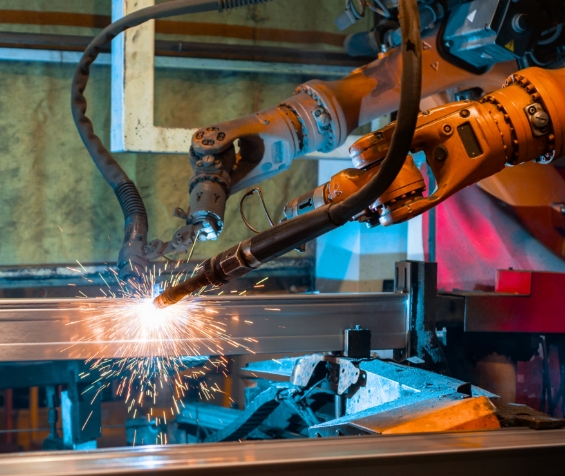
At its core, a robotic welding system is an integrated combination of motion control, power regulation, part positioning, and safety architecture. The robot arm may be the most visible component, but it is only one part of a coordinated system.
Every welding method — whether MIG, TIG, spot, or collaborative — relies on precise torch positioning, stable fixturing, and carefully controlled electrical parameters. The surrounding structure of the system determines whether weld quality remains consistent across thousands of cycles or begins to drift under production pressure.
The welding process itself defines how the system behaves. That’s where the real differences begin.
The 4 Types of Automated Welding Systems
There are four main types of welding systems with automated alternatives.
1. Robotic MIG Welding Systems
MIG welding is the most commonly automated welding process in industrial manufacturing. It uses a continuously fed wire electrode and shielding gas to create welds efficiently and at relatively high speeds.
MIG Robotic Welding Pros and Cons
Because MIG offers strong deposition rates and moderate tolerance to minor joint variation, it is often chosen for structural fabrication, heavy equipment, and automotive components. In medium-to-high volume environments, its ability to maintain throughput without excessive complexity makes it especially practical.
MIG systems are generally favored when productivity is a primary concern. They handle thicker materials effectively and perform well in repetitive production environments. However, while versatile, MIG may not provide the cosmetic finish or extreme heat control required for thin or precision components.
2. TIG Welding Robot Systems
TIG welding emphasizes precision over speed. Instead of continuously feeding filler wire, TIG relies on a non-consumable tungsten electrode to produce a highly stable arc. This allows for fine control of heat input and weld pool behavior.
Where TIG Welding Robots Excel
Robotic TIG systems are typically used in applications where weld appearance, minimal distortion, or thin materials are critical. Stainless steel assemblies, aluminum components, and industries requiring visually clean welds often benefit from TIG automation.
Where Robotic TIG Welding May Not Be a Fit
The tradeoff is cycle time. TIG is slower than MIG, and it demands tighter tolerances in part fit-up and positioning. Because it is less forgiving of variation, robotic TIG systems depend heavily on stable fixturing and consistent part presentation.
In short, TIG is chosen when quality requirements outweigh pure speed considerations.
3. Spot Welding Robotic Systems
Spot welding, often associated with sheet metal production, joins materials at discrete points using resistance heat rather than a continuous weld bead.
This process is widely used in automotive manufacturing and appliance assembly, where identical components must be joined repeatedly at high speed. Robotic spot welding systems excel in environments where part geometry remains consistent across large production runs.
How Spot Welding Systems Work
Unlike arc welding processes such as MIG or TIG, spot welding does not require filler material. Instead, it relies on pressure and electrical resistance to form the weld nugget. In high-volume lines, multiple robots may work simultaneously, each performing a sequence of spot welds in tightly synchronized cycles.
Spot welding is less adaptable to highly variable part designs, but in standardized production environments, it delivers exceptional efficiency.
4. Collaborative Welding Systems: Leverage Automation Along With Manual Welding
Collaborative welding systems, commonly referred to as cobots, differ from traditional industrial robots in both design and intent. They are built to operate in closer proximity to human operators under controlled conditions.
How Collaborative Robotic Welding Complements the Manual Welding Process
Rather than focusing solely on maximum speed, collaborative systems emphasize flexibility and accessibility. They often feature simplified programming interfaces and built-in safety monitoring, making them attractive to facilities beginning their automation journey.
Collaborative welding is especially useful in medium batch or high-mix production environments. When part designs change frequently, or when full-scale automation would require significant facility redesign, cobots offer a practical entry point.
That said, collaborative systems are not inherently “simpler” from a process standpoint. They still require precise fixturing, controlled parameters, and thoughtful workflow design to achieve consistent results.
Choosing the Right Robotic Welding System and Robotic Welding Equipment
Selecting the right robotic welding system and robotic welding equipment requires more than comparing process names or equipment specifications. Each welding method (robotic plasma welding, robotic laser welding, resistance spot welding, metal arc welding, etc) behaves differently under real production conditions.
Factors such as part thickness, joint configuration, material type, and required weld appearance also influence how a robotic welding cell should be configured. Welding thin materials, for example, demands tighter control of welding parameters and arc stability than many heavy structural welding applications.
How to Choose the Right Robotic Welding System in the Welding Industry and Manufacturing Industry
Beyond the welding process itself, manufacturers also have to evaluate the entire system architecture. The welding power supply, robot controller, welding torch configuration, and integrated safety features all influence performance and long-term reliability. Even the choice between traditional industrial robots and collaborative robots affects how welding tasks are structured on the floor. Here's a checklist of what to evaluate.
- Material type and thickness: Different welding processes behave differently depending on base material and section size. Welding thin materials may require TIG or robotic laser welding, while thicker structural components may favor metal arc welding or resistance spot welding.
- Production volume and takt time: High-volume environments often justify a fully integrated robotic welding cell designed for continuous throughput, whereas lower-volume or high-mix operations may benefit from collaborative robots that prioritize flexibility.
- Part variability and tolerance requirements: Processes with tight dimensional tolerances demand precise control of welding parameters, torch positioning, and robot controller programming. Variation tolerance directly influences process selection.
- Process complexity and welding tasks: Repetitive welding tasks are ideal for automation, but highly variable weld joints may still require input from skilled welders. Understanding which tasks are truly repeatable is essential.
- Power and equipment configuration: The welding power supply, welding torch selection, and safety features must align with the specific welding applications being performed, whether robotic plasma welding, robotic laser welding, or traditional arc processes.
- Workforce integration and long-term scalability: Automation should complement the role of skilled welders rather than displace expertise. The goal is to create a system that strengthens productivity while supporting sustainable growth within the industrial robot industry.
As a general rule, high-volume structural fabrication may favor MIG. Thin, high-precision assemblies may require TIG. Sheet metal mass production often leans toward spot welding. Flexible, mid-volume operations may benefit from collaborative systems.
The Bigger Picture: Robotic Welding Machines as Part of a Production Strategy
Regardless of which welding process is selected, long-term performance depends on how the system fits within the broader manufacturing environment. Part presentation, quality verification, and cycle balancing all influence outcomes as much as the welding method itself.
Even the most advanced robotic welding process can't compensate for inconsistent fixturing or poorly aligned upstream processes. The welding system must operate as part of a coordinated production strategy, not as a standalone tool.
Melton Machine & Control Company Can Help Match Process to Production Reality for Your Welding Operation
Understanding the types of robotic welding systems (MIG, TIG, spot, and collaborative) allows manufacturers to make decisions grounded in production logic rather than marketing claims. Each method offers distinct advantages when applied in the right context.
For more than 55 years, Melton has worked with manufacturers to evaluate these choices in real-world production environments. By designing automation around specific materials, volumes, and workflow constraints, our goal remains consistent: build systems that deliver measurable performance without unnecessary complexity.
If you're evaluating which welding process best aligns with your operation, start a conversation with us today to explore your next step.
Start a Conversation with the Melton Today
Consistency is the foundation of welding quality, and cobots are only as good as the systems that monitor and maintain them. Treating audits as a strategic investment, not a maintenance chore, ensures lasting productivity and a higher return on every automation asset.
Start a conversation with us to strengthen your cobot welding quality program and build a future defined by precision, reliability, and consistent excellence.