

How Robotic Welding Systems Improve Weld Consistency in Trailer Manufacturing
Trailer manufacturing is unforgiving work. Every weld on a finished trailer will be asked to perform under load, in variable weather conditions, across hundreds of thousands of road miles. In that environment, weld consistency is a constant structural requirement. A weld that passes visual inspection but falls short on penetration or fusion integrity doesn't show its weakness on the production floor. It shows it on the highway.
That reality puts pressure on every manufacturer building trailers at scale. High unit volumes, demanding weldment geometry, and a shrinking pool of experienced welders create conditions where manual welding consistency is difficult to sustain and where the consequences of variation are significant.
In today's note, we break down the specific consistency challenges trailer manufacturers face, and how robotic welding system weld consistency addresses them at the process level.
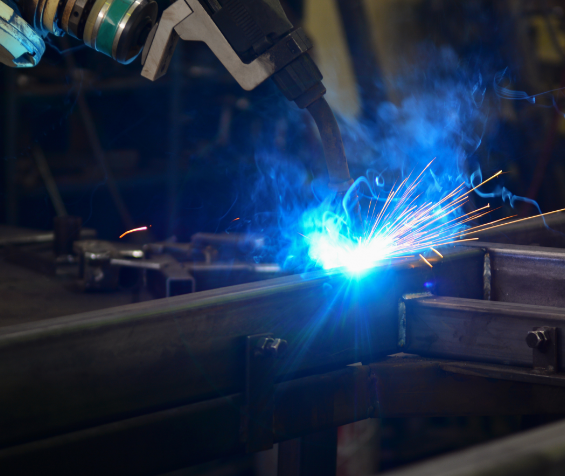
Why Weld Consistency Is a Structural Requirement in Trailer Manufacturing
Most fabricated products have tolerance for variation. Trailers don't, at least not where it matters. Frame rails, cross members, goosenecks, and hitch assemblies carry dynamic loads that stress every weld joint with every mile of operation. Regulatory standards, liability exposure, and customer safety expectations all demand that welds meet spec, not most of the time, but every time.
That standard is difficult to sustain when human operators are responsible for the entire process across high-volume, multi-shift production. Shielding gas coverage, arc stability, and travel speed all require consistent execution, whether the application calls for stick welding on heavy structural members or spot welding on lighter bracket assemblies. Each variable is manageable in isolation. Across hundreds of welds per unit, at production pace, the cumulative effect of manual variation is where quality problems develop.
Robotic welding systems are designed to improve weld quality by holding those variables constant, and unlike traditional industrial automation, modern systems can work alongside human operators rather than replacing them entirely. The robot handles the sustained, repeatable welding tasks most vulnerable to human error. Skilled welders focus on fit-up, setup, and complex joints. In other words, they do more welding that benefits most from human judgment. It's exactly the division of labor that robotic welding consistency is designed to deliver.
The 3 Weld Consistency Challenges Specific to Trailer Manufacturing
Trailer manufacturing isn't a single welding challenge; it's several compounding ones. Understanding each one separately is how manufacturers identify where automation creates the most value.
1. High Weld Counts Per Unit
A single trailer can require hundreds of individual welds before it leaves the production floor. Frame assemblies, flooring supports, stake pockets, lighting brackets, and structural gussets all demand precise, repeatable welds across a complex geometry. At that weld count, even a small percentage of variation translates into significant rework exposure and significant opportunity for defects to escape visual inspection undetected.
Manual welders produce their best work early in a shift on familiar joints. Across a full trailer build (dozens of unique joint configurations, sustained over hours of production) maintaining that consistency becomes increasingly difficult. The cumulative effect of variation across hundreds of welds is where trailer quality problems typically originate.
2. Large, Heavy Weldments and Difficult Access Angles
Trailer components are large and heavy. Frame rails run the full length of the unit. Structural assemblies require welding in positions that demand sustained awkward posture from manual operators: overhead, vertical, and confined-access joints that accelerate fatigue and compromise torch control.
Difficult access angles don't just slow production. They introduce the kind of variation that's hardest to control manually: inconsistent torch standoff distance, variable travel angle, and incomplete fusion on joints where positioning is constrained. For structural welds, those variables directly affect the integrity of the finished joint.
3. Volume Pressure and the Fatigue Factor From Manual Welding
Trailer demand is cyclical and often intense. When order volumes climb, production schedules compress, and manual welding operations absorb that pressure through overtime, accelerated pace, and reduced attention to weld quality under time constraints. Fatigue compounds variation. A welder maintaining tight parameters at hour two of a shift is a different operator than the same welder at hour nine of an overtime run.
Volume pressure is where trailer welding consistency problems tend to become visible, in rising rework rates, increased inspection failures, and quality escapes that make it into the field.
How a Robotic Welding System's Weld Consistency Solves Trailer Manufacturing Problems
Robotic welding addresses trailer manufacturing consistency challenges at the process level, not by working harder than manual welders, but by eliminating the variables that cause manual welding to drift.
Encoded Weld Parameters That Don't Drift
A robotic welding system executes every weld to a programmed specification. Amperage, voltage, travel speed, wire feed rate, and torch angle are defined, validated, and held consistently across every cycle. The first weld of the shift and the last weld of the shift are produced by the same parameters.
What Encoded Parameters Control In Trailer Welding Applications
- Heat input consistency: Precise control of amperage and travel speed ensures uniform penetration across structural joints — critical for weld integrity under dynamic load.
- Arc stability: Consistent wire feed rate and standoff distance maintain a stable welding arc regardless of operator fatigue or shift duration.
- Interpass temperature control: On multi-pass welds common in heavy trailer frames, robotic systems maintain consistent interpass timing that manual operations struggle to sustain at production pace.
- Torch angle repeatability: Programmed torch positioning eliminates the angular variation that causes incomplete fusion on access-restricted joints.
Parameters that don't drift produce welds that don't vary. That's the foundation of robotic welding consistency in structural applications.
Consistent Torch Positioning Across Every Cycle
Torch positioning is where manual welding variation is most difficult to control on complex trailer geometry. Joints in constrained locations, joints requiring specific approach angles, and joints on large weldments that require repositioning mid-seam all introduce positioning variability that affects weld quality.
How Robotic Positioning Addresses Trailer Geometry
Robotic welding cells use programmed weld paths developed and validated for each specific joint configuration. The robot arm executes those paths with repeatable precision, maintaining consistent standoff distance, travel angle, and torch orientation regardless of joint location or accessibility. On trailer frames where structural joints appear in consistent locations across every unit, that repeatability compounds across the entire build.
Positioner Integration on Large Weldments
Large trailer assemblies often require the workpiece to be repositioned during welding to present joints at optimal angles. Integrated positioner systems (headstock and tailstock configurations, tilt-rotate positioners, or custom fixtures) automate that repositioning in coordination with the robot, maintaining the precise relationship between torch and joint that manual repositioning introduces variation into.
Robot Welding Offers Repeatability at High Weld Counts
Robotic welding consistency doesn't degrade across a production run. The system that produces the first trailer of the shift produces the hundredth trailer of the shift to the same specification. That repeatability is what makes robotic welding particularly valuable in high-weld-count applications like trailer manufacturing, where the cumulative effect of sustained consistency across hundreds of joints per unit is the difference between a reliable production quality baseline and an unpredictable one.
Integrated Quality Control and Inspection
Robotic welding systems can integrate automated inspection capabilities that verify weld quality in real time: seam tracking, vision guidance, and post-weld inspection systems that flag deviations before the part moves downstream. In trailer manufacturing, where catching a deficient structural weld at the production stage is exponentially less costly than catching it in the field, that in-process quality assurance capability adds a layer of protection that manual inspection can't match at production pace.
Trailer Welding Automation in Practice — What Changes on the Floor with a Robotic Welding Process?
When robotic welding is integrated into a trailer manufacturing operation, the production environment shifts in ways that affect the entire workflow. The welding cell becomes a consistent throughput engine rather than a variable one. Skilled welders move into supervisory, setup, and finishing roles, applying their expertise to fit-up, complex joints that fall outside the automated process, and first-article inspection. Rework queues shrink as first-pass yield improves. Scheduling becomes more predictable because output per shift is no longer tied to attendance and individual performance variation.
The transition requires planning (fixture engineering, programming, and operator training all precede go-live) but the operational picture after integration is structurally more stable than the one it replaces.
Matching the Right System to Trailer Manufacturing Applications for High-Quality Welds
Trailer manufacturing typically involves both applications. Structural frame welding (long seam welds on consistent geometries at high volume) is well-suited to automated fixed welding machines, which operate at speeds and consistency levels that exceed what robotic cells can achieve on simple, repetitive paths. Complex structural assemblies with varied joint configurations and access requirements are better served by robotic welding cells, which offer the programmed flexibility to handle geometry that a fixed machine can't accommodate. Many trailer manufacturing operations benefit from both, staged across the production process to match each system type to the application it handles best.
How Melton Builds Consistency Into Trailer Welding Systems, Collaborative Robots, and More
Large, structurally demanding weldments require an integration partner with the engineering depth to handle them, not just the equipment to attempt them. Melton Machine & Control Company brings more than 55 years of welding automation experience and 1,000+ successful applications to every project, including the heavy metal fabrication and complex fixture engineering that trailer manufacturing demands.
Our robotic welding systems are designed around the specific requirements of each application, whether that means MIG welding on high-volume frame assemblies, TIG welding on precision structural joints, or arc welding applications where consistent welding parameters are critical to producing precise welds across complex welds that a human welder would struggle to sustain at production pace.
We use offline programming to develop and validate weld paths before the system ships, reducing startup time and ensuring the welding robot performs to spec from day one. Repetitive welding tasks get handled by the system. Complex welding tasks get the engineering attention they require.
Start a Conversation
At Melton, we handle every aspect of integration, from system design and fixture engineering through programming, runoff, and startup on your floor.
A solution that works for you is one that was made for you. If weld consistency is where your trailer manufacturing operation is leaving quality and capacity on the table, let's talk through what the right custom system looks like. Reach out today to start a conversation.