
Robotic Laser Welding vs. Robotic MIG Welding: Which Is Right for Your Parts?
The laser welding vs MIG welding decision comes down to your parts. Robotic laser welding is typically the stronger fit for thin materials, precision parts, and high-volume lines where low distortion is important. Robotic MIG welding is usually the preferred choice for thicker materials, variable fit-up, and a lower entry cost. Many manufacturers end up needing both.
This guide compares the two processes on speed, heat input, fit-up tolerance, material thickness, and cost, then covers where each one wins and when a hybrid approach makes sense.
Laser Welding vs. MIG Welding: What Sets the Two Apart?
MIG welding is a form of arc welding. An electric arc melts a consumable wire that serves as filler metal, while shielding gas protects the weld pool. Wire feeders, torches, and power sources are well-established, and the process is familiar on most shop floors.
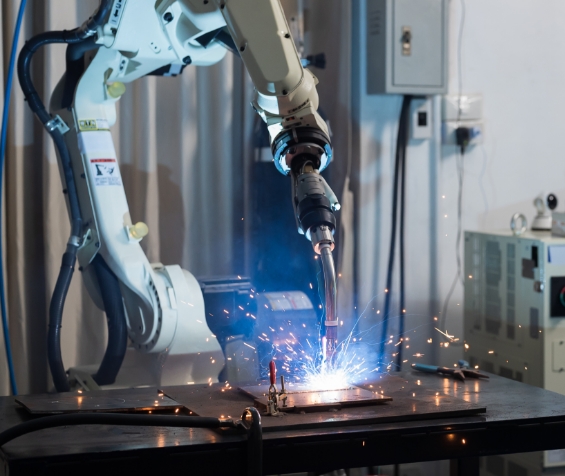
Robotic laser welding uses a focused laser beam as the heat source. A laser source generates the beam, optics deliver it, and the robot arm moves it along the seam, often without filler metal. The core components of a laser cell are the laser source, the optics, the robot, and a safety enclosure. Manual welding and TIG welding still have a place in low-volume work, but both comparisons below assume a robotic cell.
Comparing Both Robot Welding Processes
Welding Speed
On thin materials, laser welding is generally much faster. The concentrated beam melts the joint almost instantly, so travel speed can far exceed what MIG achieves on the same part. On thicker joints, MIG stays competitive because it deposits filler metal in larger passes.
Heat Input and Distortion
A focused laser beam puts energy into a very small spot, which creates a small heat-affected zone and minimal distortion. That helps sheet metal fabrication, where less warping means less straightening after welding. MIG puts more heat into the part, so the heat-affected zone is wider, and thin gauge parts are more prone to warping. It also produces more spatter. Good fixturing and pulse MIG parameters reduce these effects, and automated inspection systems can confirm weld integrity and catch distortion early, which helps reduce rework.
Joint Fit-Up Tolerance
This is where MIG wins. A laser beam is narrow, so gaps must be tight and consistent, and the beam has to land precisely on the seam. MIG’s filler metal bridges gaps and forgives variation in stamped or cut parts. Vision systems and seam tracking help laser cells find the joint, but part quality and fixtures and tooling still carry much of the load.
Material Thickness
Laser power sets the range. Lower-power systems excel on thin materials, while higher-power lasers can make deep welds with real penetration depth in a single pass. Even so, MIG remains the usual route for heavy-duty structural joints on thicker materials, especially where joint prep varies.
Cost to Buy and Cost per Part
Laser welding robots carry higher upfront costs. The laser source, safety enclosure, and tighter fixturing all add to the investment. A MIG welding robot has a lower entry cost, and for smaller runs, collaborative robot welding can offer a lower-cost path to automation.
Purchase price is only part of the picture, though. Cost per part depends on cycle time, rework, consumables, and post-weld cleanup. At high volume, laser speed and minimal spatter can make it the more cost-effective option. For lower volumes or varied parts, MIG often delivers a faster return on the investment.
When to Choose One Over the Other
Neither process is better across the board. Each one earns its place on certain parts, and the clearest differences show up in material thickness, fit-up consistency, and production volume. Here is where each tends to come out ahead:
- Thin Gauge Parts (Laser): Low heat input and high speed produce precise welds with a clean weld appearance.
- Battery Trays and Enclosures (Laser): Minimal distortion helps maintain consistent weld quality on thin, leak-sensitive assemblies.
- Thicker Structural Welds (MIG): Filler metal and multi-pass capability handle heavy sections and wider gaps.
- Variable or Lower-Volume Parts (MIG): Fit-up tolerance and lower setup demands suit mixed production.
Different industries may find one process more beneficial over the other or use a hybrid approach. For example, the automotive industry benefits from using multiple processes. Laser welding often serves thin body and battery components, while MIG remains common on chassis and structural parts.
What About Hybrid Laser-Arc Welding?
Hybrid laser-arc welding combines both heat sources in a single weld pool. The laser provides deep penetration and speed, while the arc adds filler metal and gap tolerance. The result is a process that can weld thicker materials faster than arc welding alone while forgiving more fit-up variation than a laser by itself.
The tradeoff is complexity. Hybrid cells need coordinated motion between the laser and the arc, plus more setup and process control. It tends to suit high-volume work on thicker sections, such as heavy fabrication, and it isn’t necessary for most applications.
How to Choose the Right Process
Start with the parts, not the technology. The comparisons above point to a few practical questions worth answering before you commit:
- Part Consistency: Can you hold tight, repeatable fit-up from your suppliers, or does it vary from lot to lot?
- Production Mix: Will one part run for years, or will the cell handle frequent changeovers?
- Surface Preparation: Are parts clean and consistent on arrival? Contamination hurts laser and MIG welds alike.
If the answers don’t point clearly one way, an experienced integrator can evaluate your parts honestly. The right answer is sometimes MIG, sometimes laser, and sometimes both. Melton designs both MIG and robotic laser welding cells, so recommendations follow your parts instead of a single process.
Why Work with Melton for Robotic Welding Automation
Choosing between laser and MIG is easier with a partner that listens to your needs and offers a tailored solution. Melton Machine & Control Company has spent more than 55 years designing and building automated welding systems, and as a 100% employee-owned company, its engineers care about your outcomes long after installation. Rather than offering a catalog of standard cells, Melton starts with your parts, your production goals, and the conditions on your floor. The team compares laser, MIG, and hybrid options against your real requirements, including fit-up, cycle time, and cost per part, then designs a custom system built around them.
Powering the Next Generation of EV Manufacturing
The rapid growth of market demand for electric vehicles is creating significant opportunities for component manufacturers to expand EV production capabilities, increase capacity, and support the future of automotive innovation, but it also introduces new levels of complexity. If you’re evaluating how to optimize production or prepare your operation for the next generation of EV manufacturing, now is the time to assess whether your current processes are built to scale. Our team can evaluate your existing assembly process, identify opportunities to add EV component manufacturing automation, and recommend solutions tailored to your needs.